

Cluster profile types
StreamNative Cloud offers two cluster profiles. Pick the one that matches your workload’s latency and cost priorities.Latency-Optimized profile
The Latency-Optimized cluster profile is designed for real-time, interactive, and mission-critical workloads that require consistently fast data access and low end-to-end latency. Backed by high-performance disk storage, this profile delivers predictable, single-digit to tens-of-milliseconds latency for producers and consumers, making it ideal for use cases such as event processing, fraud detection, user activity tracking, and any application where responsiveness directly impacts user experience or business outcomes. By prioritizing speed over cost, the Latency-Optimized profile ensures smooth, high-throughput performance even under demanding conditions.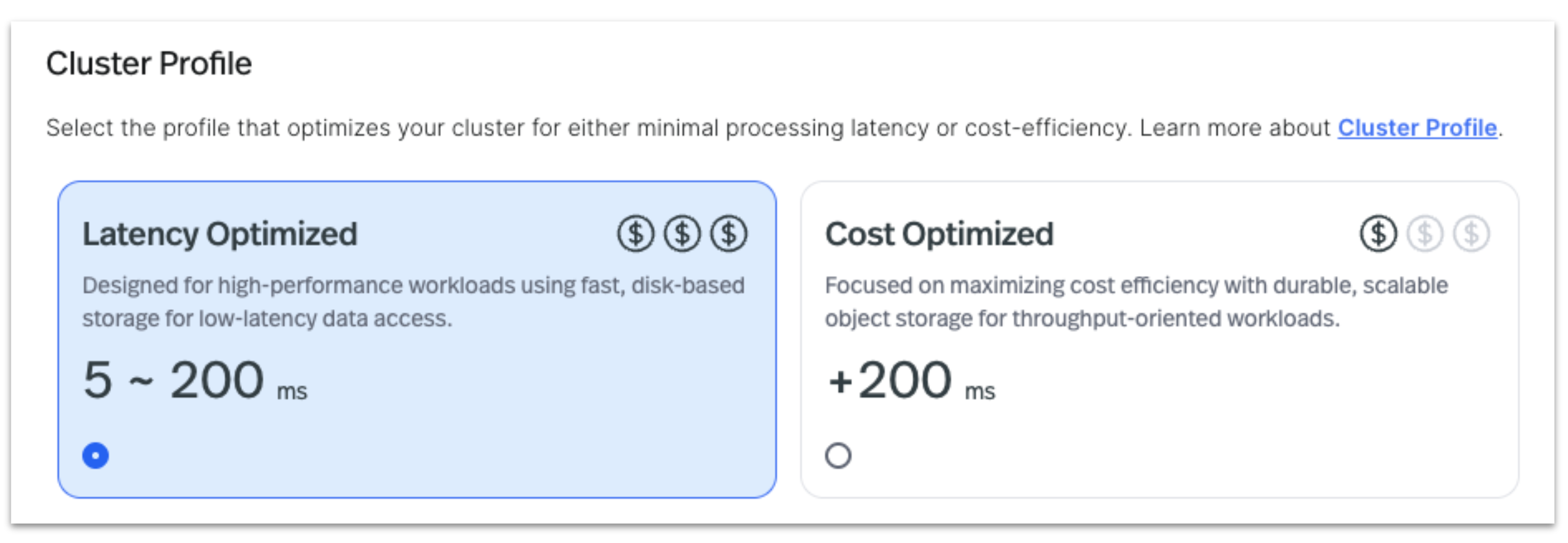
- Pulsar Clusters use Apache BookKeeper as the low-latency WAL. The metadata store is ZooKeeper by default; Oxia is available on request. Pulsar Clusters support the native Pulsar protocol, and the Kafka protocol is available through the KSN protocol handler with full Kafka feature parity. Lakehouse integration (Iceberg, Delta) is built in via the URSA storage layer.
- Kafka Clusters use KRaft and local disks as the low-latency WAL, delivering native Apache Kafka with the full Kafka feature set. Lakehouse integration is built in.
Cost-Optimized profile
The Cost-Optimized cluster profile is engineered for throughput-intensive and cost-sensitive workloads that benefit from large-scale, durable, and economical object storage. While this profile accepts higher access latencies—typically in the hundreds of milliseconds—it provides significant cost savings and unlimited scalability, making it a strong fit for data pipelines, analytics sinks, long-term retention, and applications that do not require ultra-fast consumption. By leveraging object storage, the Cost-Optimized profile offers an efficient balance of price, durability, and flexibility for workloads where latency tolerance is higher and storage economics matter most.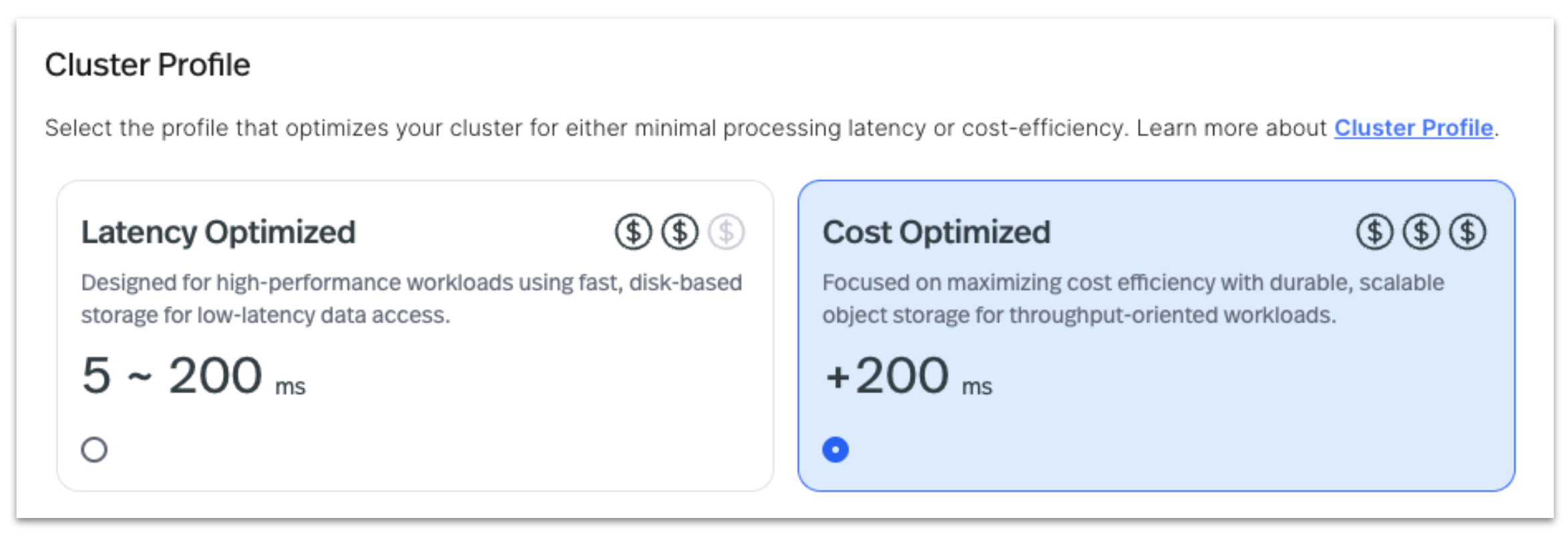
- Pulsar Clusters currently expose the Kafka-compatible protocol only on the Cost-Optimized profile. Native Pulsar protocol support for this profile is coming after the Apache Pulsar 5.0 release. Lakehouse integration is built in.
- Kafka Clusters expose the native Kafka protocol with lakehouse integration built in. Kafka transactions and topic compaction on the Cost-Optimized profile are coming soon.
Pulsar Clusters
Pulsar Clusters support all three deployment options. Serverless automatically manages performance and cost characteristics without user-defined profiles.On Pulsar Clusters, the Cost-Optimized profile currently supports the Kafka-compatible protocol only. Native Pulsar protocol support for this profile is coming after the Apache Pulsar 5.0 release.
Supported deployment options
* Cost-Optimized BYOC Pulsar Clusters currently support the Kafka-compatible protocol only. Native Pulsar protocol support is coming after the Apache Pulsar 5.0 release.
Supported features by deployment type
- Serverless
- Dedicated
- BYOC
Cluster profiles do not apply to Serverless deployments. Serverless automatically manages performance and cost characteristics without user-defined profiles.
Kafka Clusters
Kafka Clusters are currently in Public Preview. For a comparison with Kafka compatibility on Pulsar Clusters (KSN), see Kafka Cluster vs. KSN.
Kafka transactions and topic compaction on the Cost-Optimized profile are coming soon. Use the Latency-Optimized profile today if your workloads require these features.
Supported deployment options
Supported features by deployment type
- Serverless
- Dedicated
- BYOC
Serverless Kafka clusters support both latency-optimized and cost-optimized service characteristics. StreamNative automatically manages capacity and performance characteristics, so you don’t need to choose a cluster profile during Serverless Kafka cluster creation.