> ## Documentation Index
> Fetch the complete documentation index at: https://docs.streamnative.io/llms.txt
> Use this file to discover all available pages before exploring further.
# Data Streaming Engine
StreamNative Cloud runs all cluster profiles on the **URSA engine** — a cloud-native data streaming engine at the heart of the [Lakestream architecture](/cloud/overview/lakestream-overview). URSA supports multiple write-ahead log (WAL) implementations and metadata stores, so each cluster profile can be tuned for latency or cost without switching engines.
Every StreamNative Cloud cluster — Pulsar or Kafka, Latency-Optimized or Cost-Optimized — runs on URSA. The profile determines the WAL, metadata store, and exposed protocols. Native Pulsar protocol support on the Cost-Optimized profile is coming after the Apache Pulsar 5.0 release; today, Cost-Optimized Pulsar Clusters expose the Kafka-compatible protocol.
## URSA engine
URSA is StreamNative's unified stream storage engine, recognized with the **VLDB 2025 Best Industry Paper** award. It provides the storage layer for Lakestream and delivers:
* **Native Kafka support** for Kafka Clusters.
* **Native Pulsar support** for Pulsar Clusters (on the Latency-Optimized profile today; on Cost-Optimized after Apache Pulsar 5.0).
* **Multiple WAL options** — Apache BookKeeper for Pulsar low-latency, KRaft + local disks for Kafka low-latency, and object storage (Amazon S3, Google Cloud Storage, Azure Blob Storage) for cost-optimized profiles.
* **Multiple metadata stores** — ZooKeeper, Oxia, or KRaft, depending on cluster type and profile.
* **Lakehouse integration** across all profiles, with data available in Iceberg and Delta Lake formats on open object storage.
### Cluster profile configurations
Each cluster profile maps to a specific WAL, metadata store, and protocol surface:
| Profile / Cluster type | WAL | Metadata store | Protocols | Caveats |
| ---------------------------- | ------------------------------------------------------------ | ------------------------------------ | -------------------------------------------------------------------------------------------- | ----------------------------------------------------------------- |
| **Latency-Optimized Pulsar** | Apache BookKeeper | ZooKeeper (default); Oxia on request | Pulsar (native); Kafka via [KSN](/kafka/kafka-cluster-vs-ksn) with full Kafka feature parity | — |
| **Cost-Optimized Pulsar** | Object Storage (Amazon S3, Google Cloud Storage, Azure Blob) | Oxia | Kafka-compatible only | Native Pulsar protocol coming after the Apache Pulsar 5.0 release |
| **Latency-Optimized Kafka** | Local disk (KRaft + ISR) | KRaft | Kafka (native) | — |
| **Cost-Optimized Kafka** | Object Storage (Amazon S3, Google Cloud Storage, Azure Blob) | Oxia | Kafka (native) | Kafka transactions and topic compaction coming soon |
See [Cluster Profiles Overview](/cloud/clusters/cluster-profiles-overview) for deployment-option availability (Serverless, Dedicated, BYOC).
### Classic configuration (legacy naming)
**Classic** is a historical label for the Apache Pulsar deployment configuration that uses ZooKeeper for metadata and Apache BookKeeper for WAL. It is the default configuration for Latency-Optimized Pulsar Clusters today and remains the reference implementation for low-latency Pulsar workloads. In current documentation, this configuration is an option within the URSA engine — not a separate engine.
If you see "Classic Engine" referenced elsewhere in StreamNative materials, it refers to this Latency-Optimized Pulsar configuration (BookKeeper WAL + ZooKeeper metadata). The Kafka protocol is available on this configuration through the KSN protocol handler with full Kafka feature parity.
### Ursa Stream Storage
At the heart of the URSA engine is the concept of **Ursa Stream Storage** — a headless, multi-modal data storage layer built on lakehouse formats.
For Cost-Optimized profiles, Ursa Stream Storage uses a WAL implementation based on object storage. This design writes records directly to object storage services like Amazon S3, bypassing BookKeeper and eliminating the need for inter-broker replication. Brokers are stateless and leaderless, meaning any broker can handle produce or fetch requests for any partition. This eliminates inter-AZ replication traffic and reduces network costs by up to 95%, at the cost of higher end-to-end latency (typically sub-second, tunable down to \~200 ms).
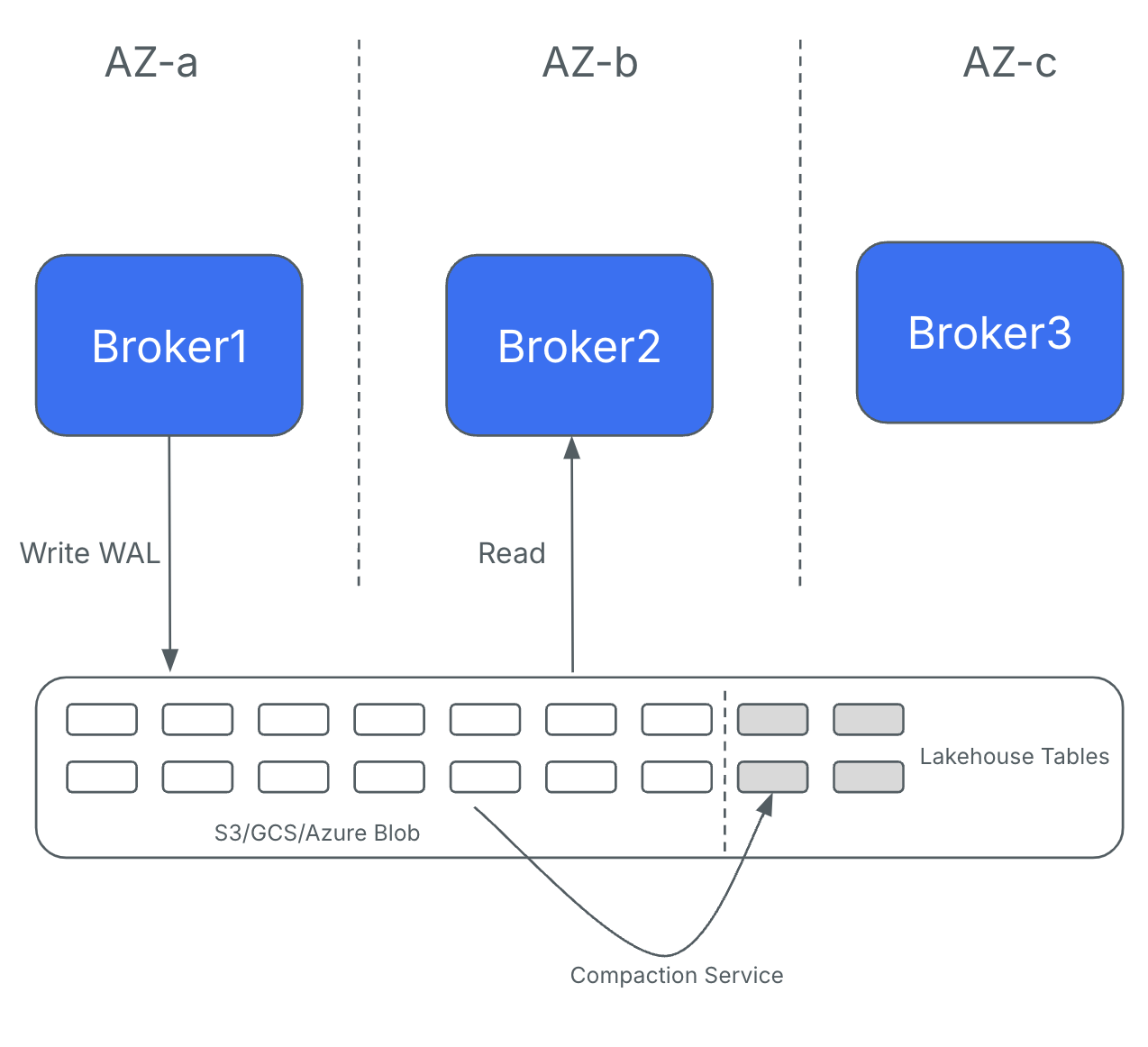 For Latency-Optimized profiles, URSA uses disk-based WALs (Apache BookKeeper for Pulsar, KRaft + local disks for Kafka) to deliver single-digit to tens-of-milliseconds end-to-end latency.
## Compare cluster profiles
Use this summary to pick the profile that matches your workload. For the full feature matrix, see [Cluster Profiles Overview](/cloud/clusters/cluster-profiles-overview).
| Feature | Latency-Optimized Pulsar | Cost-Optimized Pulsar | Latency-Optimized Kafka | Cost-Optimized Kafka |
| ------------------------ | ------------------------------------------------------ | --------------------------------------------------- | -------------------------------- | --------------------------------------------------- |
| **Pulsar protocol** | Yes (native) | Coming after Pulsar 5.0 | N/A | N/A |
| **Kafka protocol** | Yes (via KSN, full feature parity) | Yes (Kafka-compatible) | Yes (native) | Yes (native) |
| **Storage backend** | Local disk (BookKeeper) | Object storage | Local disk (KRaft + ISR) | Object storage |
| **Metadata store** | ZooKeeper (default), Oxia on request | Oxia | KRaft | Oxia |
| **End-to-end latency** | Single-digit to tens of ms | Sub-second (tunable to \~200 ms) | Single-digit to tens of ms | Sub-second (tunable to \~200 ms) |
| **Inter-AZ replication** | Required | Eliminated (direct to object storage) | Required | Eliminated (direct to object storage) |
| **Lakehouse storage** | Built in (Iceberg, Delta) | Built in (Iceberg, Delta) | Built in (Iceberg, Delta) | Built in (Iceberg, Delta) |
| **Caveats** | — | Native Pulsar protocol not yet available | — | Kafka transactions and topic compaction coming soon |
| **Best for** | Real-time messaging, mission-critical Pulsar workloads | Lakehouse ingestion, analytics, Kafka-API workloads | Real-time Kafka, fraud detection | Event streaming, log aggregation, CDC |
## Choose the right profile for your workload
* **Latency-Optimized Pulsar** — when you need native Pulsar protocol (flexible subscriptions, multi-tenancy, geo-replication) with sub-10 ms latency.
* **Cost-Optimized Pulsar** — when you need Kafka-compatible access to Pulsar Clusters with object-storage economics, and you can wait for native Pulsar protocol on this profile.
* **Latency-Optimized Kafka** — when you need native Apache Kafka with full feature support at sub-10 ms latency.
* **Cost-Optimized Kafka** — when you need native Apache Kafka at up to 95% lower infrastructure cost, and your workload does not require Kafka transactions or topic compaction yet.
For Latency-Optimized profiles, URSA uses disk-based WALs (Apache BookKeeper for Pulsar, KRaft + local disks for Kafka) to deliver single-digit to tens-of-milliseconds end-to-end latency.
## Compare cluster profiles
Use this summary to pick the profile that matches your workload. For the full feature matrix, see [Cluster Profiles Overview](/cloud/clusters/cluster-profiles-overview).
| Feature | Latency-Optimized Pulsar | Cost-Optimized Pulsar | Latency-Optimized Kafka | Cost-Optimized Kafka |
| ------------------------ | ------------------------------------------------------ | --------------------------------------------------- | -------------------------------- | --------------------------------------------------- |
| **Pulsar protocol** | Yes (native) | Coming after Pulsar 5.0 | N/A | N/A |
| **Kafka protocol** | Yes (via KSN, full feature parity) | Yes (Kafka-compatible) | Yes (native) | Yes (native) |
| **Storage backend** | Local disk (BookKeeper) | Object storage | Local disk (KRaft + ISR) | Object storage |
| **Metadata store** | ZooKeeper (default), Oxia on request | Oxia | KRaft | Oxia |
| **End-to-end latency** | Single-digit to tens of ms | Sub-second (tunable to \~200 ms) | Single-digit to tens of ms | Sub-second (tunable to \~200 ms) |
| **Inter-AZ replication** | Required | Eliminated (direct to object storage) | Required | Eliminated (direct to object storage) |
| **Lakehouse storage** | Built in (Iceberg, Delta) | Built in (Iceberg, Delta) | Built in (Iceberg, Delta) | Built in (Iceberg, Delta) |
| **Caveats** | — | Native Pulsar protocol not yet available | — | Kafka transactions and topic compaction coming soon |
| **Best for** | Real-time messaging, mission-critical Pulsar workloads | Lakehouse ingestion, analytics, Kafka-API workloads | Real-time Kafka, fraud detection | Event streaming, log aggregation, CDC |
## Choose the right profile for your workload
* **Latency-Optimized Pulsar** — when you need native Pulsar protocol (flexible subscriptions, multi-tenancy, geo-replication) with sub-10 ms latency.
* **Cost-Optimized Pulsar** — when you need Kafka-compatible access to Pulsar Clusters with object-storage economics, and you can wait for native Pulsar protocol on this profile.
* **Latency-Optimized Kafka** — when you need native Apache Kafka with full feature support at sub-10 ms latency.
* **Cost-Optimized Kafka** — when you need native Apache Kafka at up to 95% lower infrastructure cost, and your workload does not require Kafka transactions or topic compaction yet.