> ## Documentation Index
> Fetch the complete documentation index at: https://docs.streamnative.io/llms.txt
> Use this file to discover all available pages before exploring further.
# Unity Catalog Managed Iceberg Table on AWS
This guide describes how to prepare a Databricks Unity Catalog for use with StreamNative Ursa as a managed Iceberg table catalog on AWS.
## Prerequisites
* A Databricks account with Unity Catalog and Iceberg Managed Table enabled
* An AWS account with permissions to create S3 buckets and IAM roles
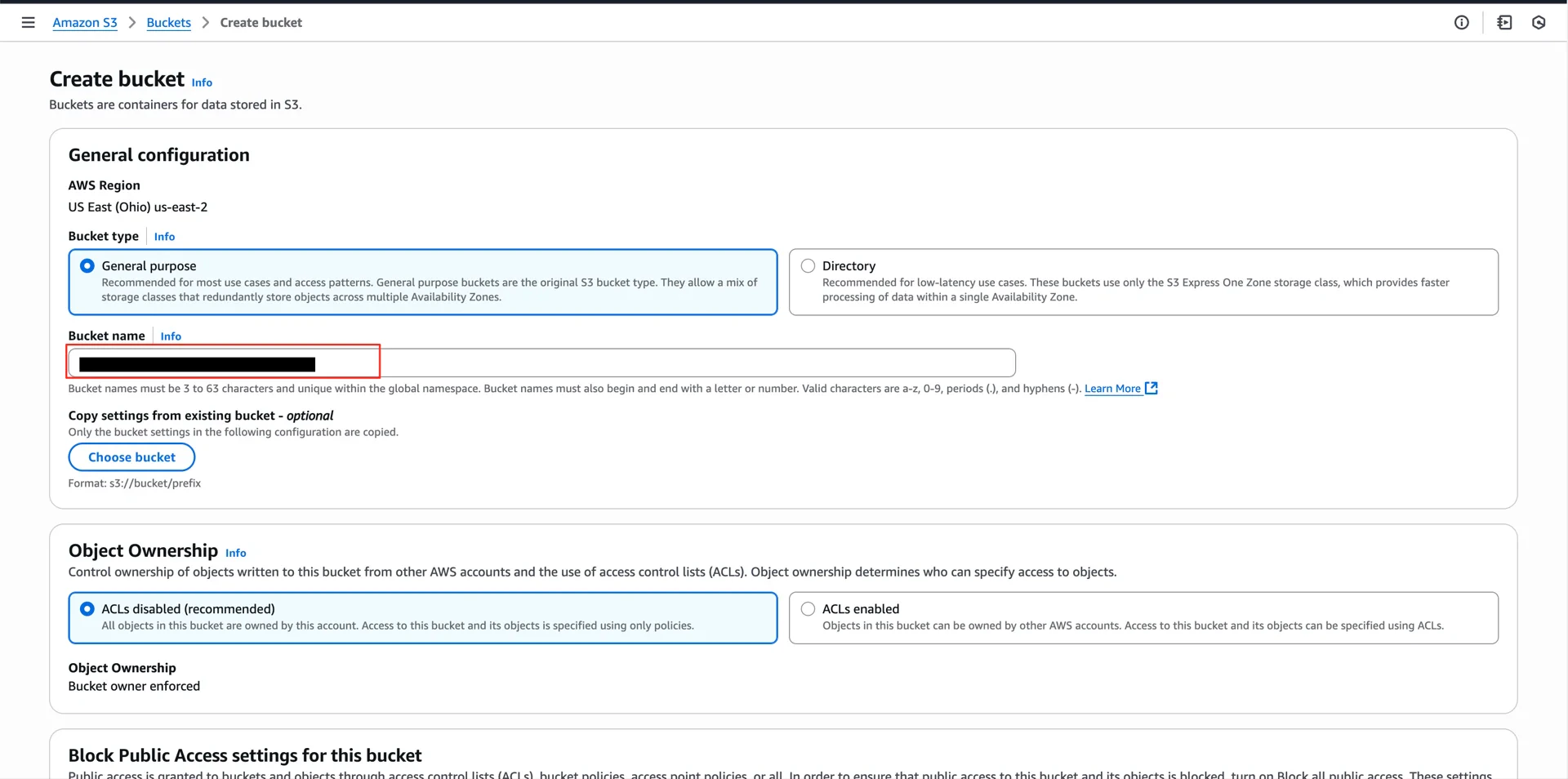
## 1. Create an S3 Bucket
In your AWS account, create an S3 bucket to use as the Unity Catalog storage location (for example, `aws-unitycatalog-iceberg-bucket`).
 ## 2. Create the IAM Role
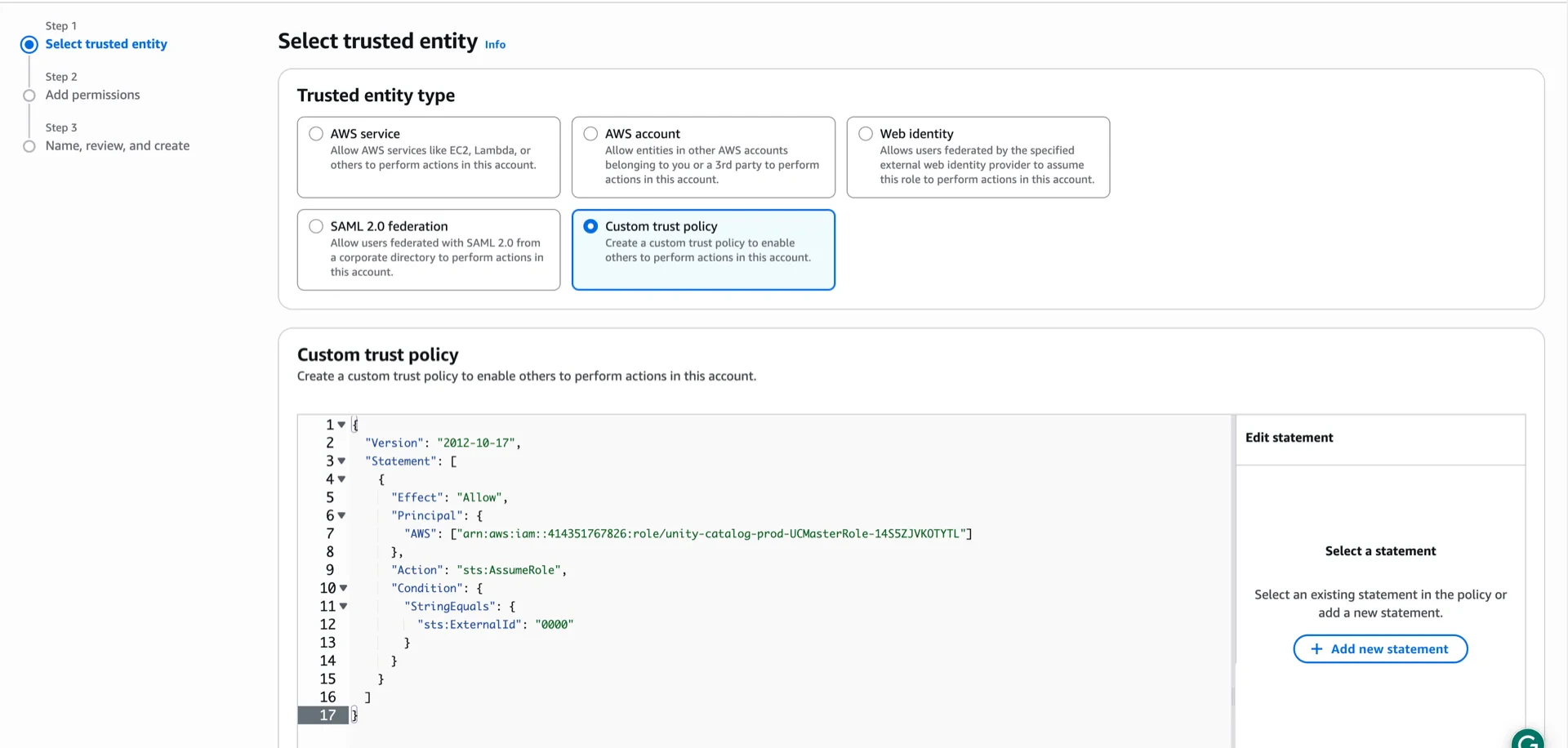
### 2.1 Create the Role with a Placeholder Trust Policy
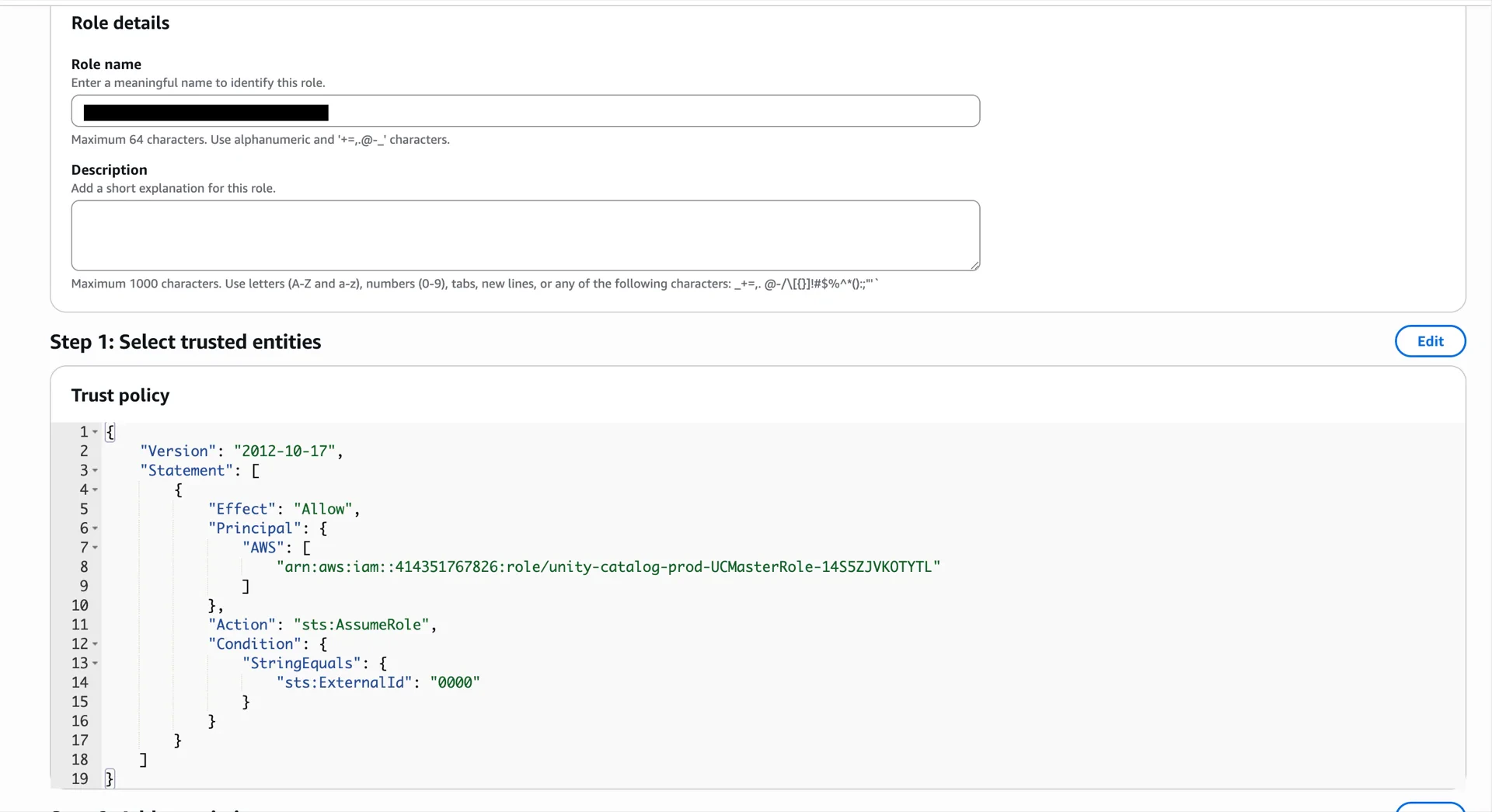
Create an IAM role that allows the Unity Catalog master role to assume it. Use the following trust policy with a placeholder `External ID` of `0000` (you will replace it with the value generated by Databricks in step 3):
```json theme={null}
{
"Version": "2012-10-17",
"Statement": [
{
"Effect": "Allow",
"Principal": {
"AWS": ["arn:aws:iam::414351767826:role/unity-catalog-prod-UCMasterRole-14S5ZJVKOTYTL"]
},
"Action": "sts:AssumeRole",
"Condition": {
"StringEquals": {
"sts:ExternalId": "0000"
}
}
}
]
}
```
Skip the permissions policy on this screen -- it will be added in the next steps.
## 2. Create the IAM Role
### 2.1 Create the Role with a Placeholder Trust Policy
Create an IAM role that allows the Unity Catalog master role to assume it. Use the following trust policy with a placeholder `External ID` of `0000` (you will replace it with the value generated by Databricks in step 3):
```json theme={null}
{
"Version": "2012-10-17",
"Statement": [
{
"Effect": "Allow",
"Principal": {
"AWS": ["arn:aws:iam::414351767826:role/unity-catalog-prod-UCMasterRole-14S5ZJVKOTYTL"]
},
"Action": "sts:AssumeRole",
"Condition": {
"StringEquals": {
"sts:ExternalId": "0000"
}
}
}
]
}
```
Skip the permissions policy on this screen -- it will be added in the next steps.
 ### 2.2 Attach the S3 Access Policy
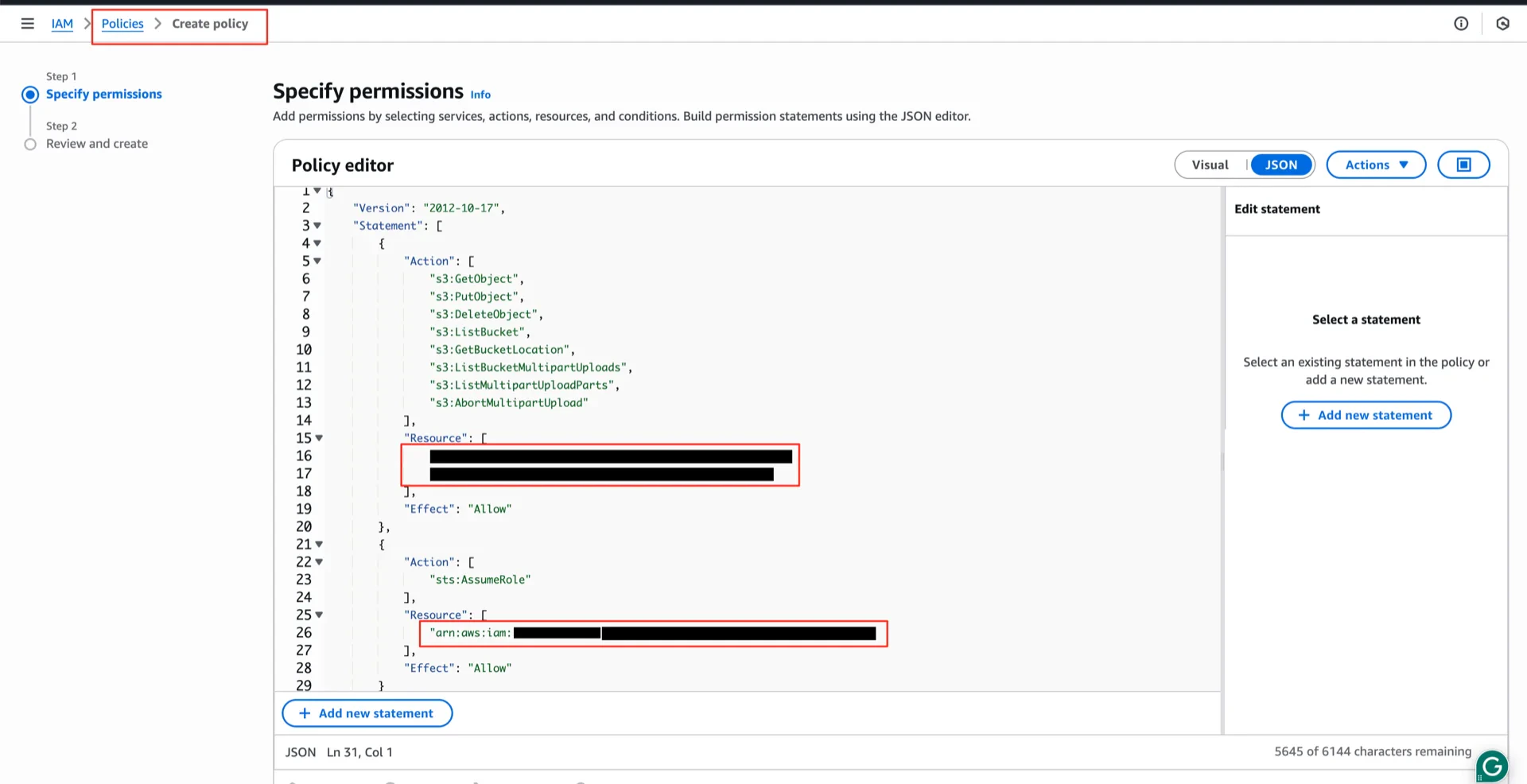
Create the following policy and attach it to the role. Replace `` and `` with your values.
```json theme={null}
{
"Version": "2012-10-17",
"Statement": [
{
"Effect": "Allow",
"Action": [
"s3:GetObject",
"s3:PutObject",
"s3:DeleteObject",
"s3:ListBucket",
"s3:GetBucketLocation",
"s3:ListBucketMultipartUploads",
"s3:ListMultipartUploadParts",
"s3:AbortMultipartUpload"
],
"Resource": [
"arn:aws:s3:::/*",
"arn:aws:s3:::"
]
},
{
"Effect": "Allow",
"Action": ["sts:AssumeRole"],
"Resource": ["arn:aws:iam:::role/"]
}
]
}
```
### 2.2 Attach the S3 Access Policy
Create the following policy and attach it to the role. Replace `` and `` with your values.
```json theme={null}
{
"Version": "2012-10-17",
"Statement": [
{
"Effect": "Allow",
"Action": [
"s3:GetObject",
"s3:PutObject",
"s3:DeleteObject",
"s3:ListBucket",
"s3:GetBucketLocation",
"s3:ListBucketMultipartUploads",
"s3:ListMultipartUploadParts",
"s3:AbortMultipartUpload"
],
"Resource": [
"arn:aws:s3:::/*",
"arn:aws:s3:::"
]
},
{
"Effect": "Allow",
"Action": ["sts:AssumeRole"],
"Resource": ["arn:aws:iam:::role/"]
}
]
}
```
 ### 2.3 Attach the File Events Policy
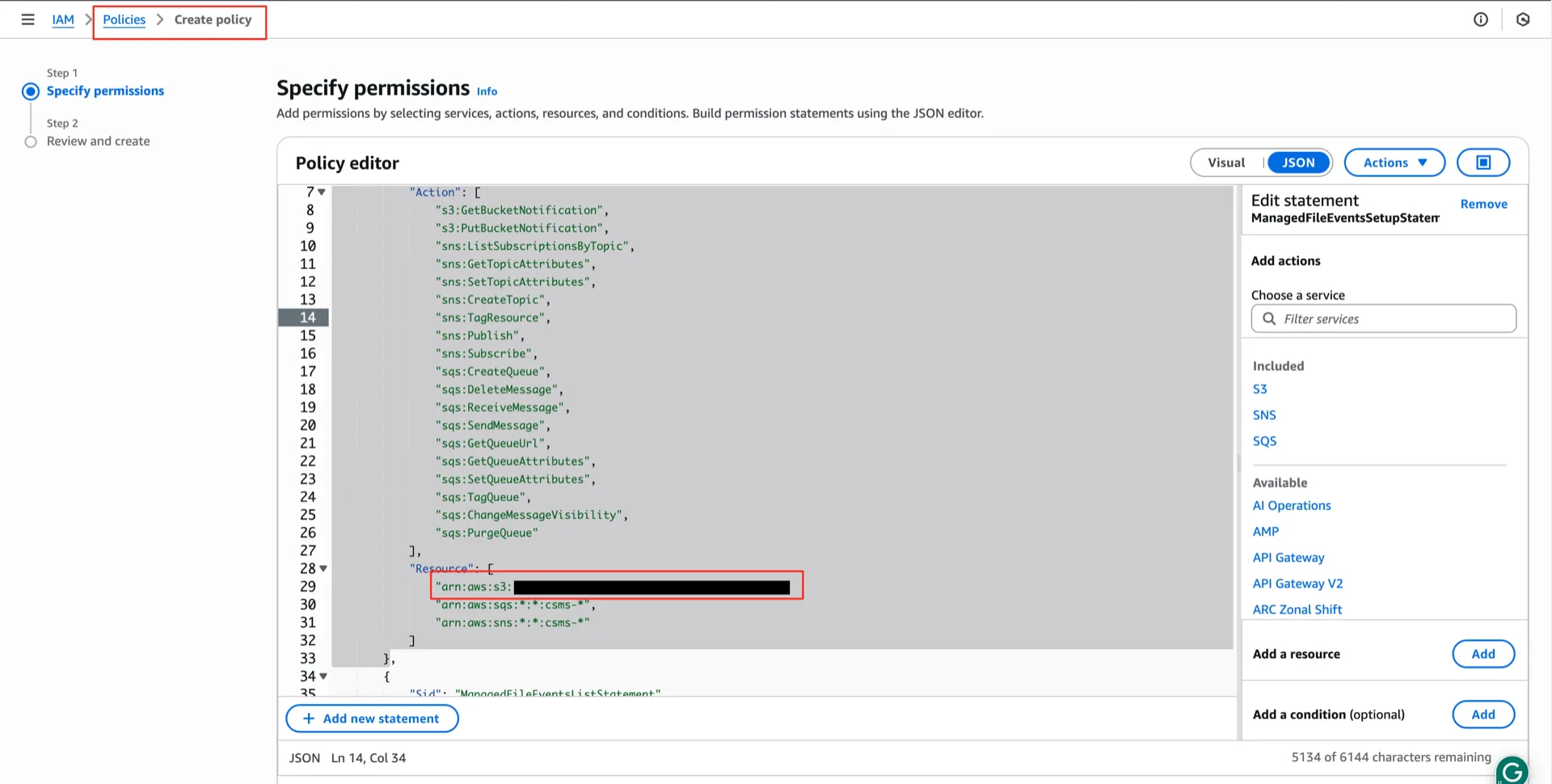
Create a second policy for managed file events (S3 notifications, SNS, SQS) and attach it to the same role:
```json theme={null}
{
"Version": "2012-10-17",
"Statement": [
{
"Sid": "ManagedFileEventsSetupStatement",
"Effect": "Allow",
"Action": [
"s3:GetBucketNotification",
"s3:PutBucketNotification",
"sns:ListSubscriptionsByTopic",
"sns:GetTopicAttributes",
"sns:SetTopicAttributes",
"sns:CreateTopic",
"sns:TagResource",
"sns:Publish",
"sns:Subscribe",
"sqs:CreateQueue",
"sqs:DeleteMessage",
"sqs:ReceiveMessage",
"sqs:SendMessage",
"sqs:GetQueueUrl",
"sqs:GetQueueAttributes",
"sqs:SetQueueAttributes",
"sqs:TagQueue",
"sqs:ChangeMessageVisibility",
"sqs:PurgeQueue"
],
"Resource": [
"arn:aws:s3:::",
"arn:aws:sqs:*:*:csms-*",
"arn:aws:sns:*:*:csms-*"
]
},
{
"Sid": "ManagedFileEventsListStatement",
"Effect": "Allow",
"Action": [
"sqs:ListQueues",
"sqs:ListQueueTags",
"sns:ListTopics"
],
"Resource": [
"arn:aws:sqs:*:*:csms-*",
"arn:aws:sns:*:*:csms-*"
]
},
{
"Sid": "ManagedFileEventsTeardownStatement",
"Effect": "Allow",
"Action": [
"sns:Unsubscribe",
"sns:DeleteTopic",
"sqs:DeleteQueue"
],
"Resource": [
"arn:aws:sqs:*:*:csms-*",
"arn:aws:sns:*:*:csms-*"
]
}
]
}
```
### 2.3 Attach the File Events Policy
Create a second policy for managed file events (S3 notifications, SNS, SQS) and attach it to the same role:
```json theme={null}
{
"Version": "2012-10-17",
"Statement": [
{
"Sid": "ManagedFileEventsSetupStatement",
"Effect": "Allow",
"Action": [
"s3:GetBucketNotification",
"s3:PutBucketNotification",
"sns:ListSubscriptionsByTopic",
"sns:GetTopicAttributes",
"sns:SetTopicAttributes",
"sns:CreateTopic",
"sns:TagResource",
"sns:Publish",
"sns:Subscribe",
"sqs:CreateQueue",
"sqs:DeleteMessage",
"sqs:ReceiveMessage",
"sqs:SendMessage",
"sqs:GetQueueUrl",
"sqs:GetQueueAttributes",
"sqs:SetQueueAttributes",
"sqs:TagQueue",
"sqs:ChangeMessageVisibility",
"sqs:PurgeQueue"
],
"Resource": [
"arn:aws:s3:::",
"arn:aws:sqs:*:*:csms-*",
"arn:aws:sns:*:*:csms-*"
]
},
{
"Sid": "ManagedFileEventsListStatement",
"Effect": "Allow",
"Action": [
"sqs:ListQueues",
"sqs:ListQueueTags",
"sns:ListTopics"
],
"Resource": [
"arn:aws:sqs:*:*:csms-*",
"arn:aws:sns:*:*:csms-*"
]
},
{
"Sid": "ManagedFileEventsTeardownStatement",
"Effect": "Allow",
"Action": [
"sns:Unsubscribe",
"sns:DeleteTopic",
"sqs:DeleteQueue"
],
"Resource": [
"arn:aws:sqs:*:*:csms-*",
"arn:aws:sns:*:*:csms-*"
]
}
]
}
```
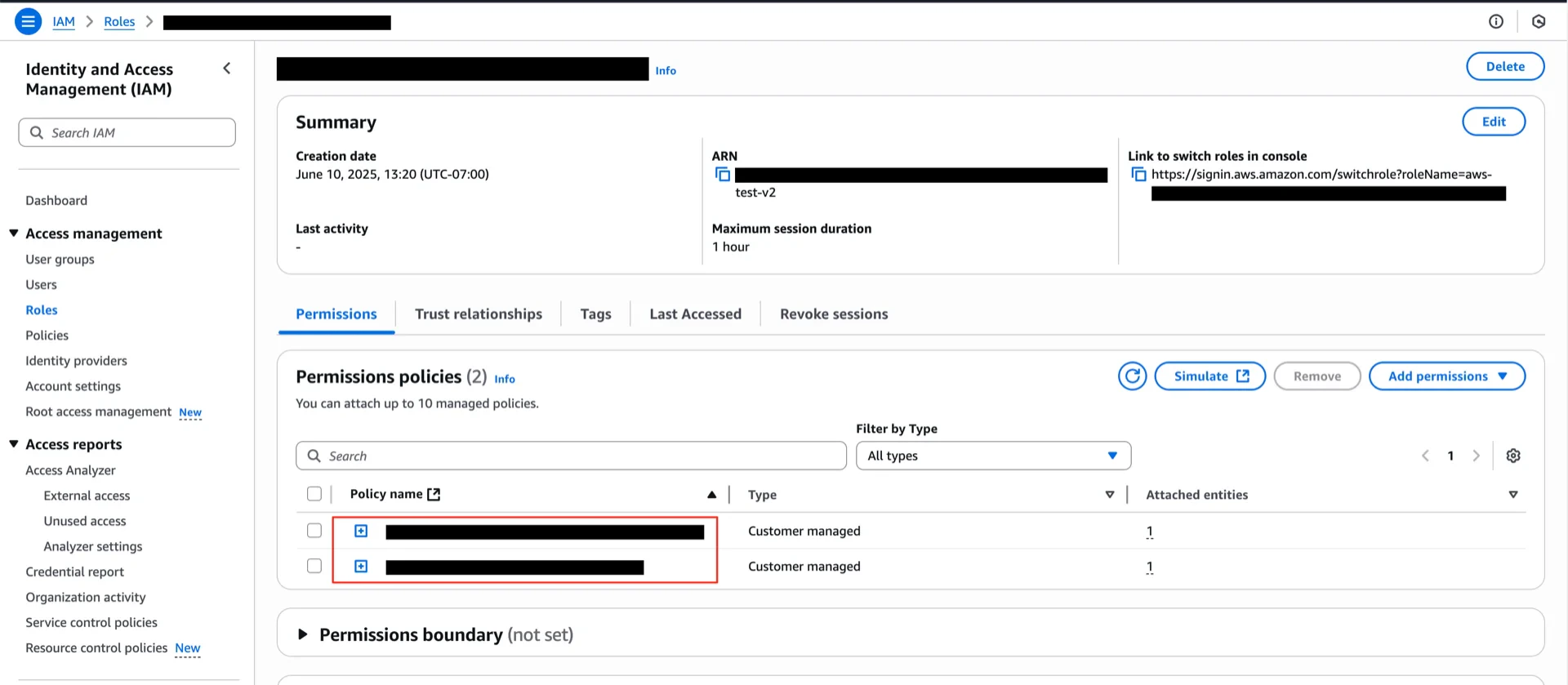
 Verify that both policies are attached to the role.
 ## 3. Create an External Location in Unity Catalog
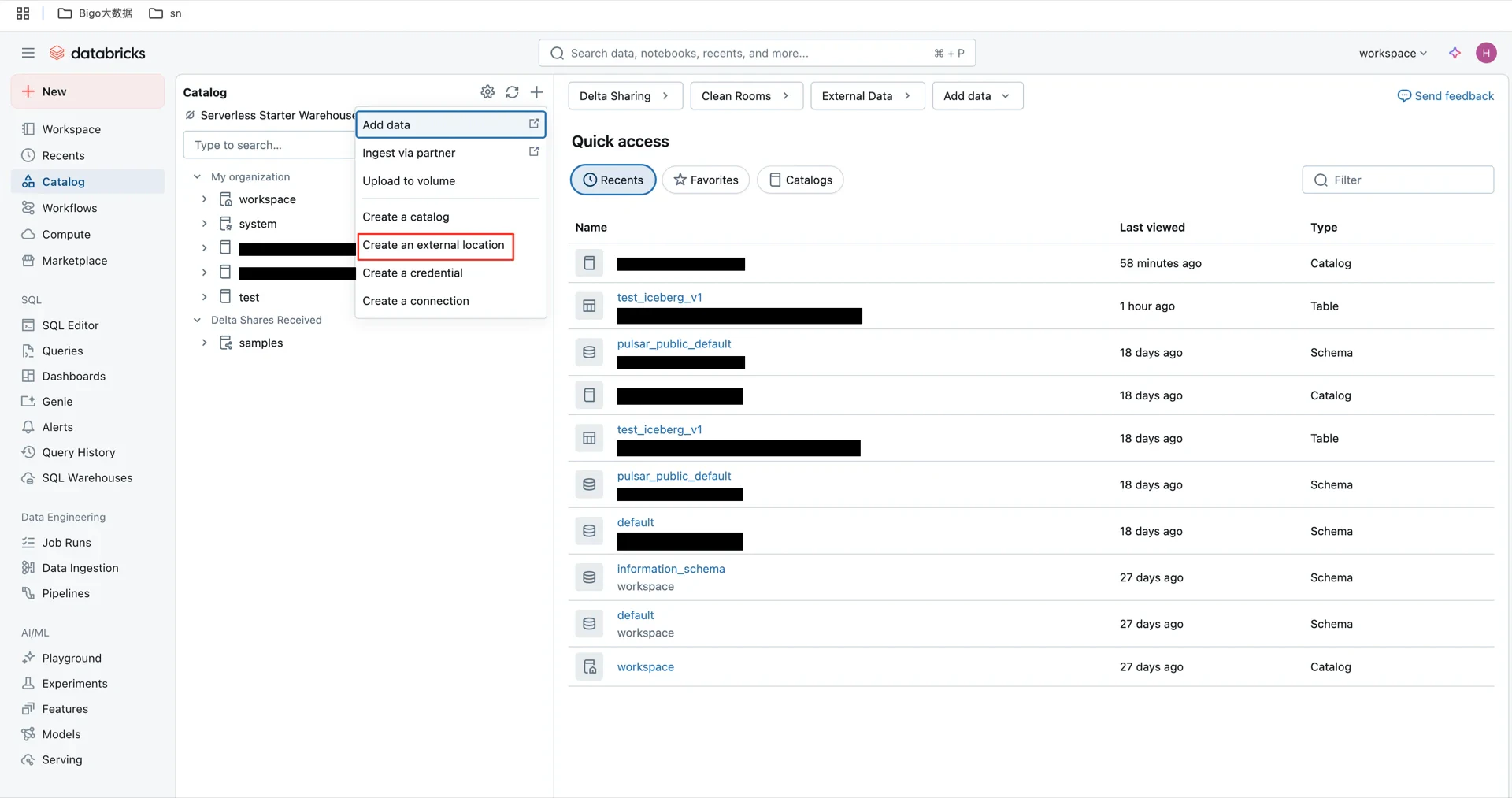
In the Databricks Catalog console, create a new external location pointing to the S3 bucket and the IAM role created above.
## 3. Create an External Location in Unity Catalog
In the Databricks Catalog console, create a new external location pointing to the S3 bucket and the IAM role created above.
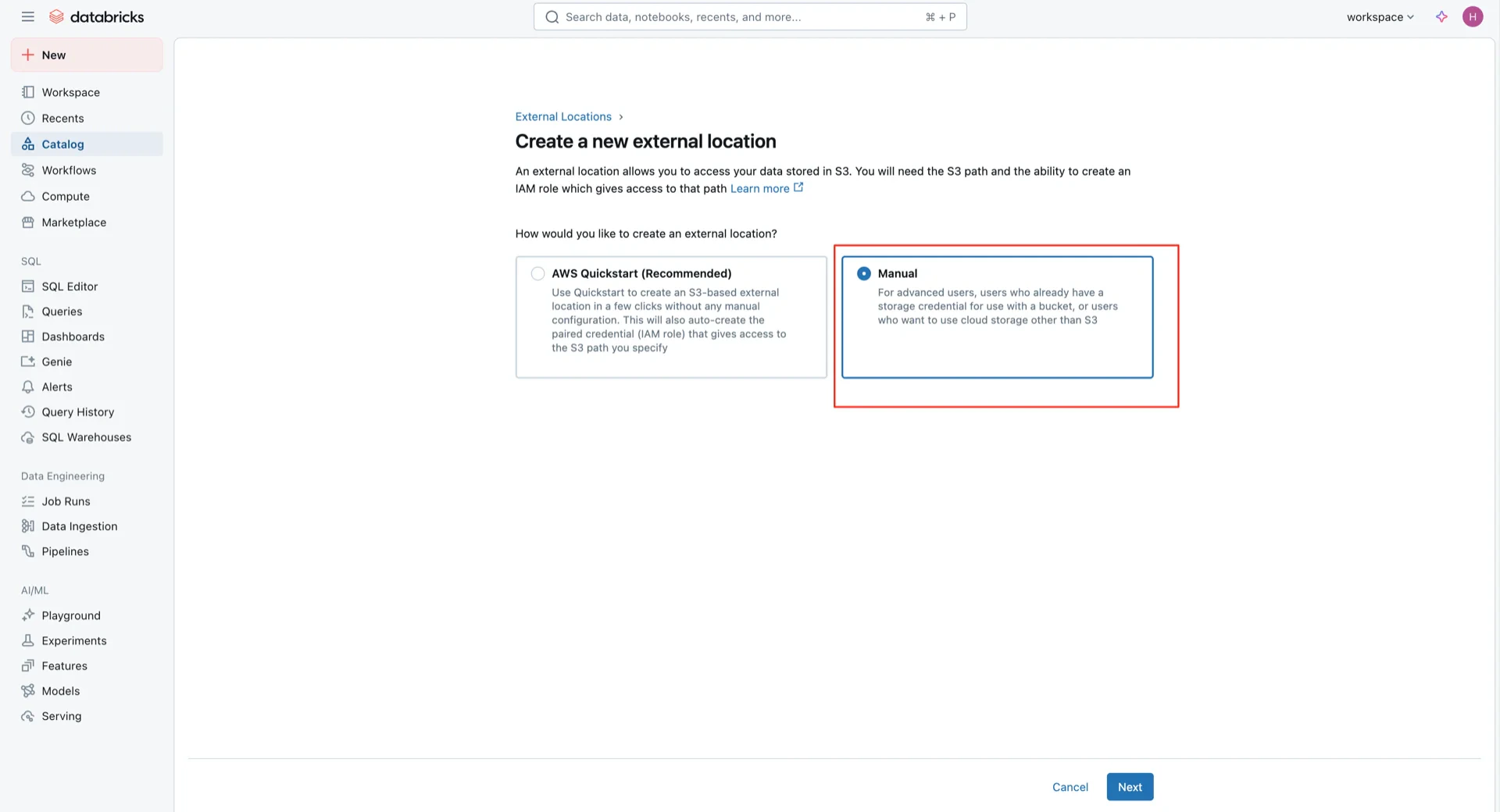
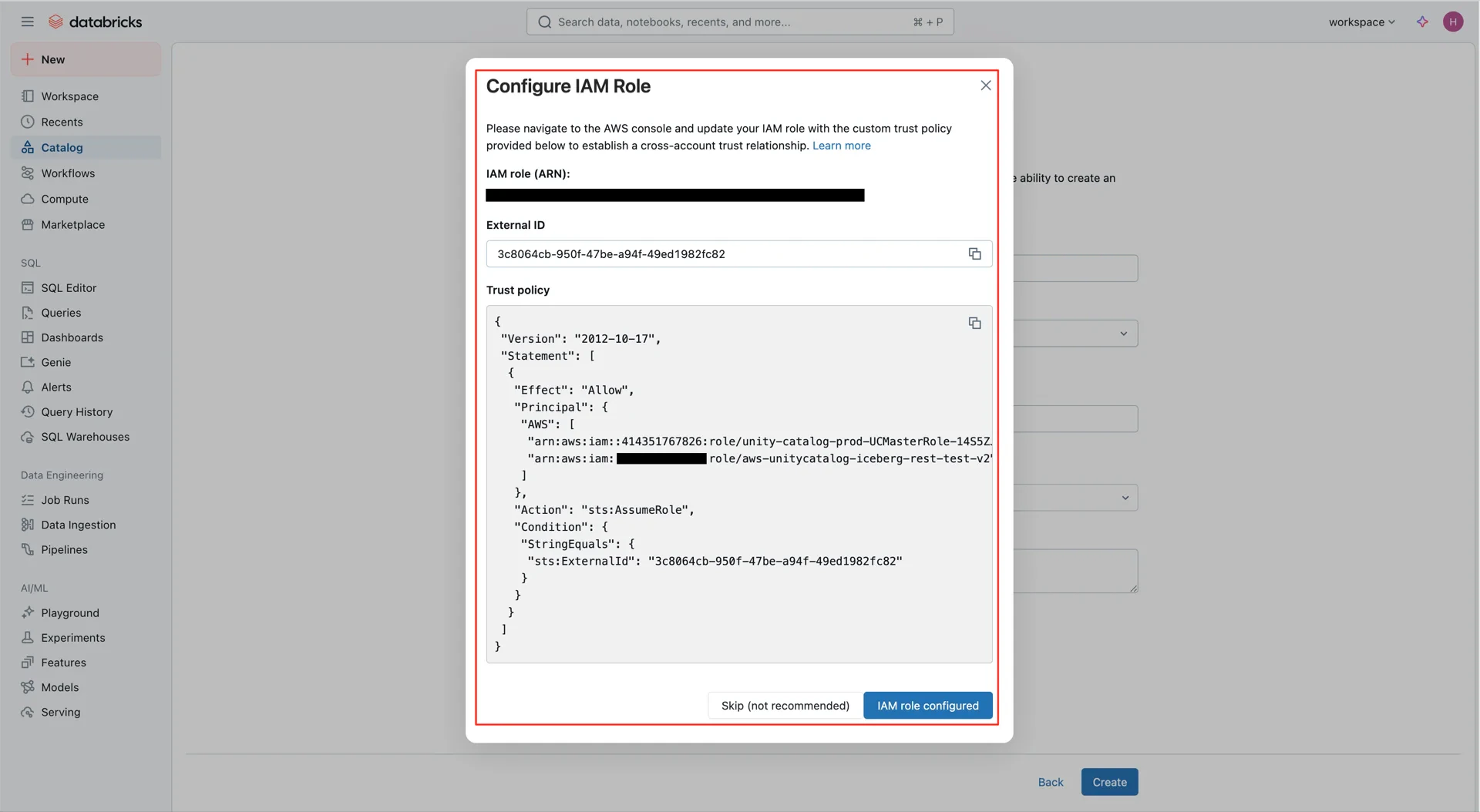
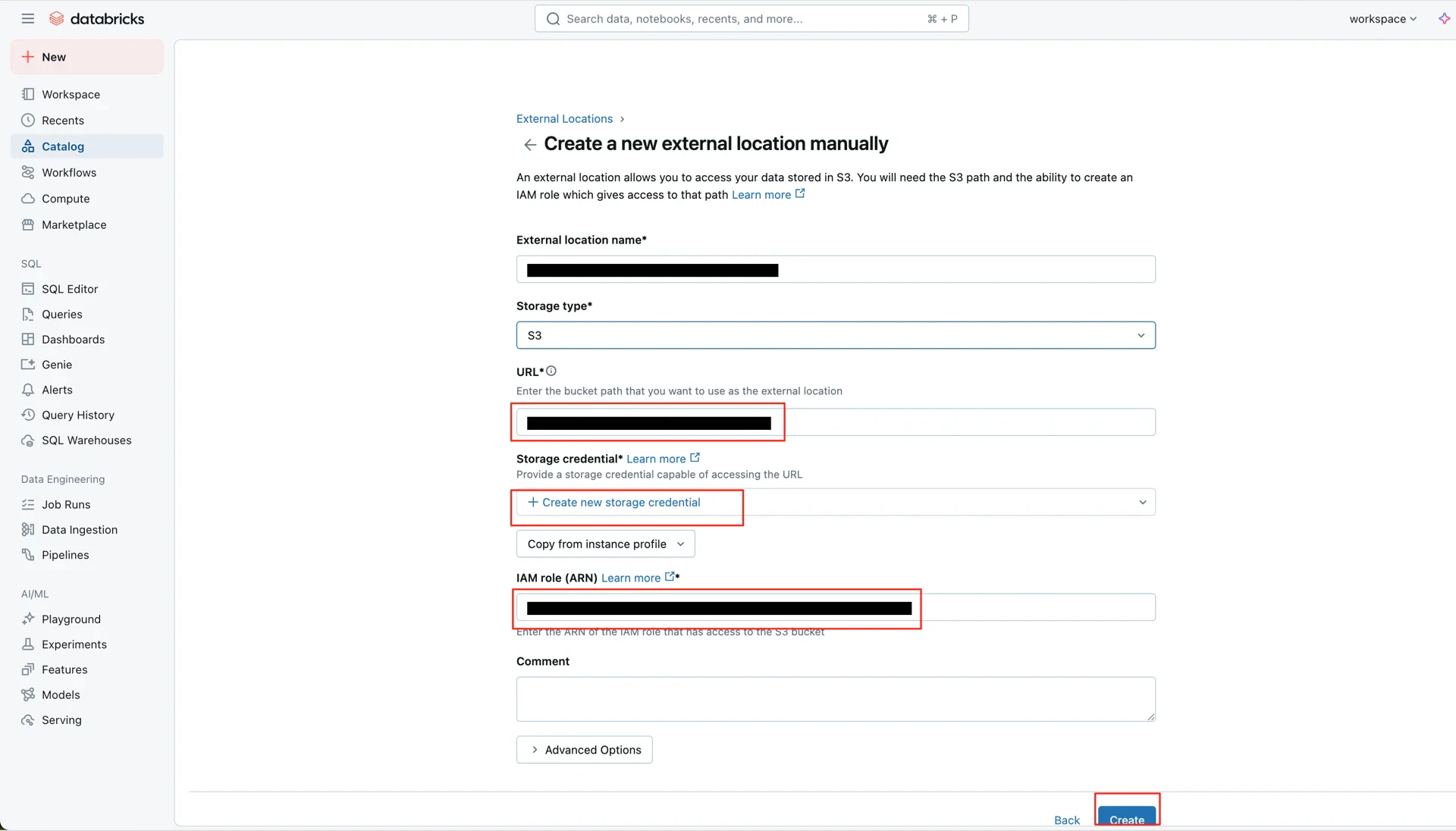 When you submit the form, Databricks generates an **External ID** and a trust policy. Copy these values.
 ## 4. Update the IAM Role Trust Policy
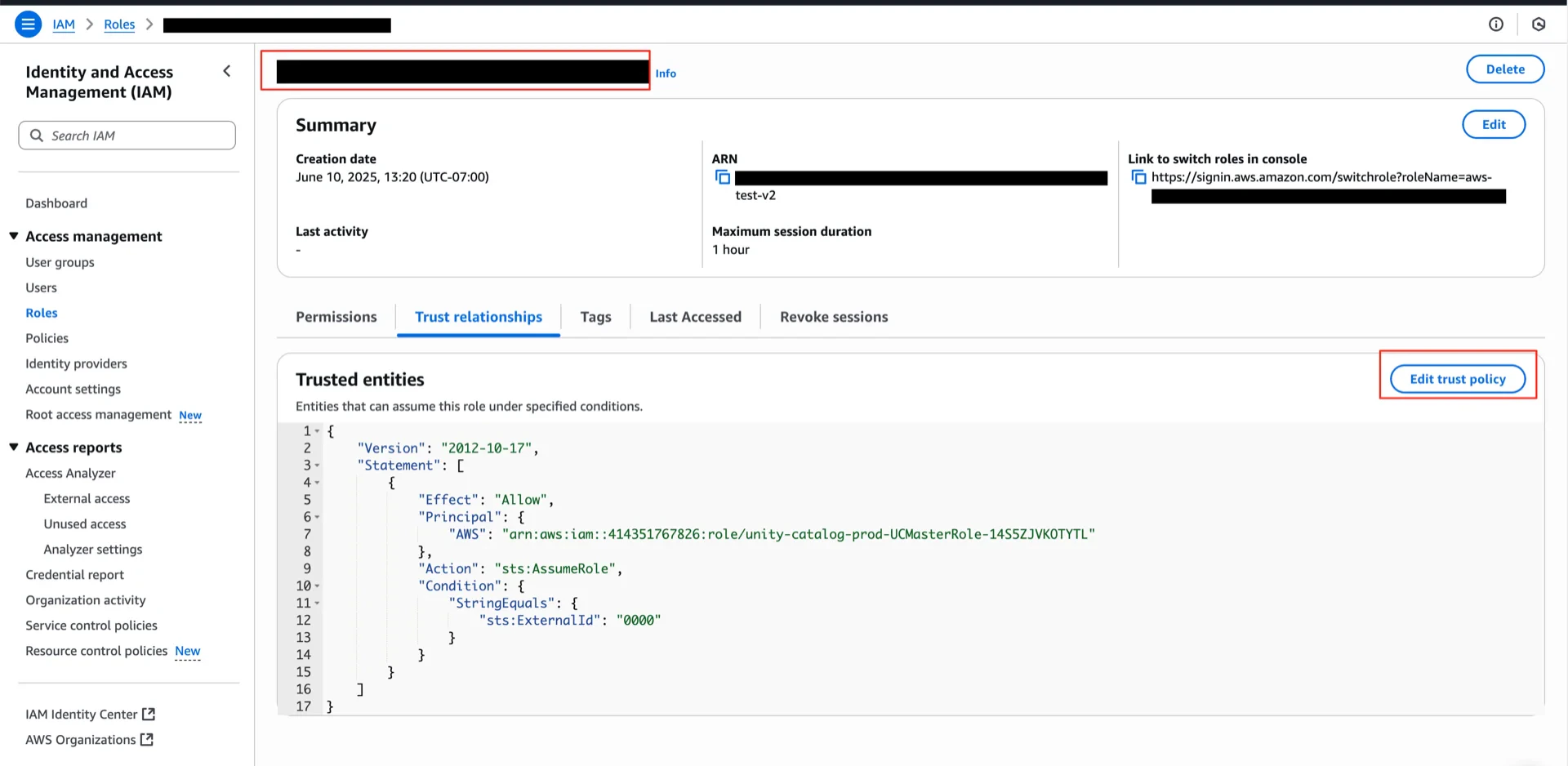
Return to the AWS IAM console and replace the role's trust policy with the one generated by Databricks in step 3, using the new External ID.
## 4. Update the IAM Role Trust Policy
Return to the AWS IAM console and replace the role's trust policy with the one generated by Databricks in step 3, using the new External ID.
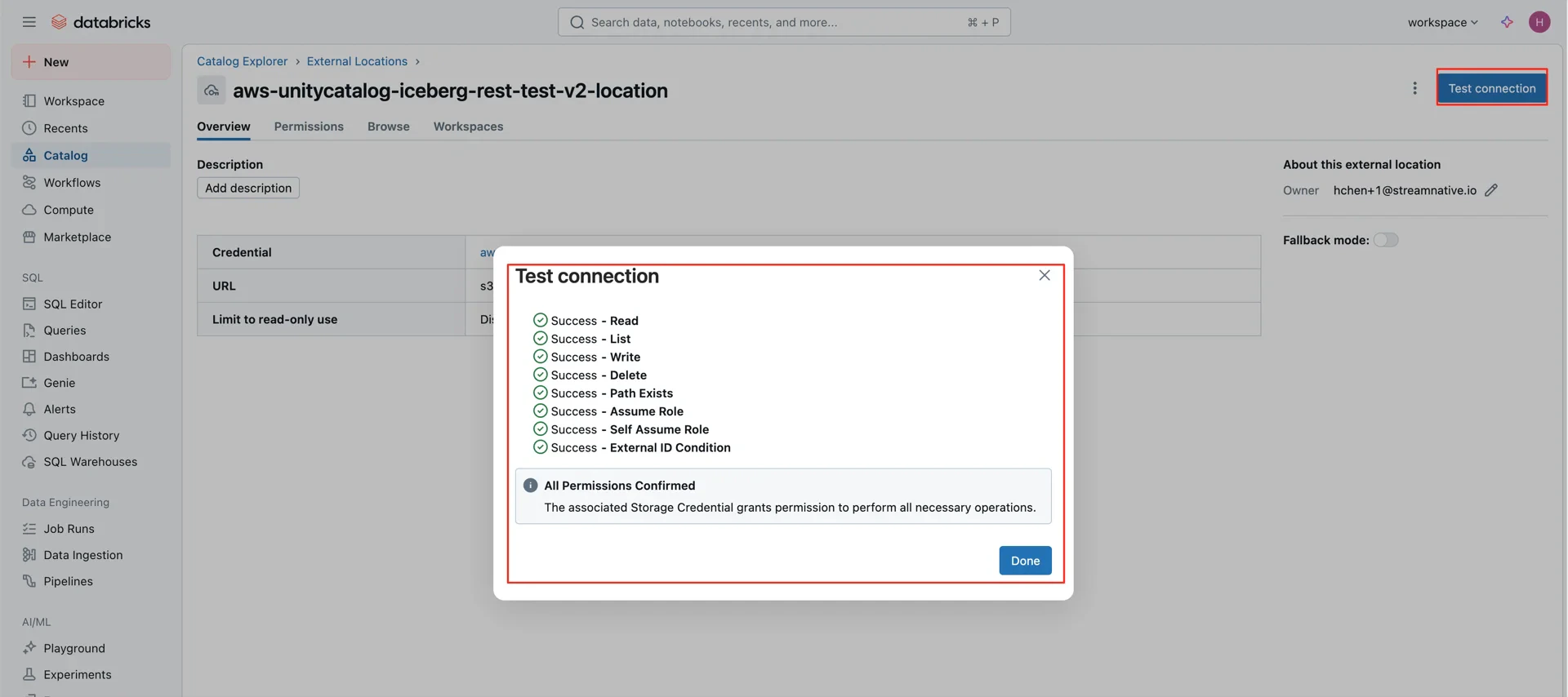
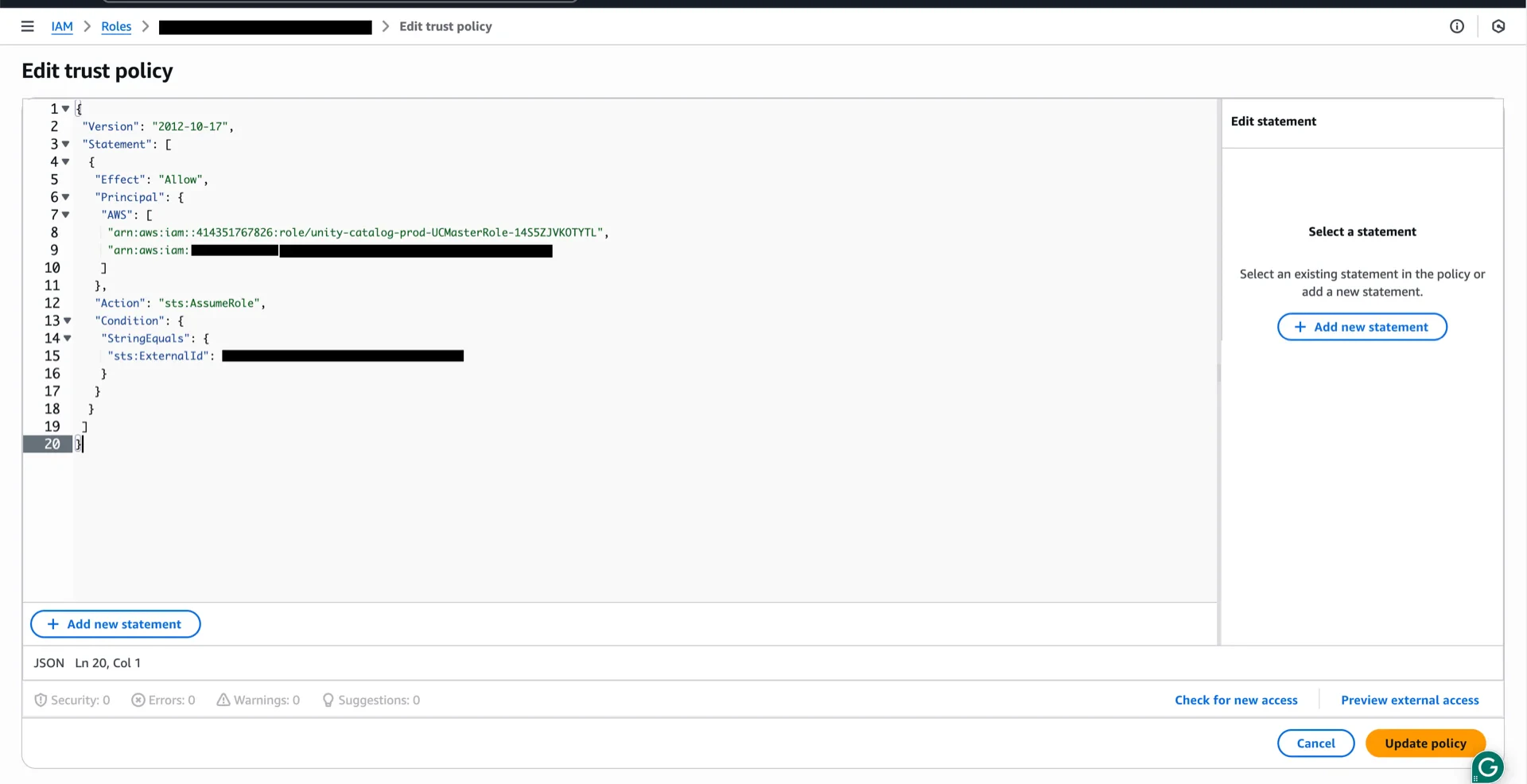 After saving the trust policy, click **IAM role configured** in the Databricks catalog console and then **Test connection** to verify the credential.
 ## 5. Create the Unity Catalog
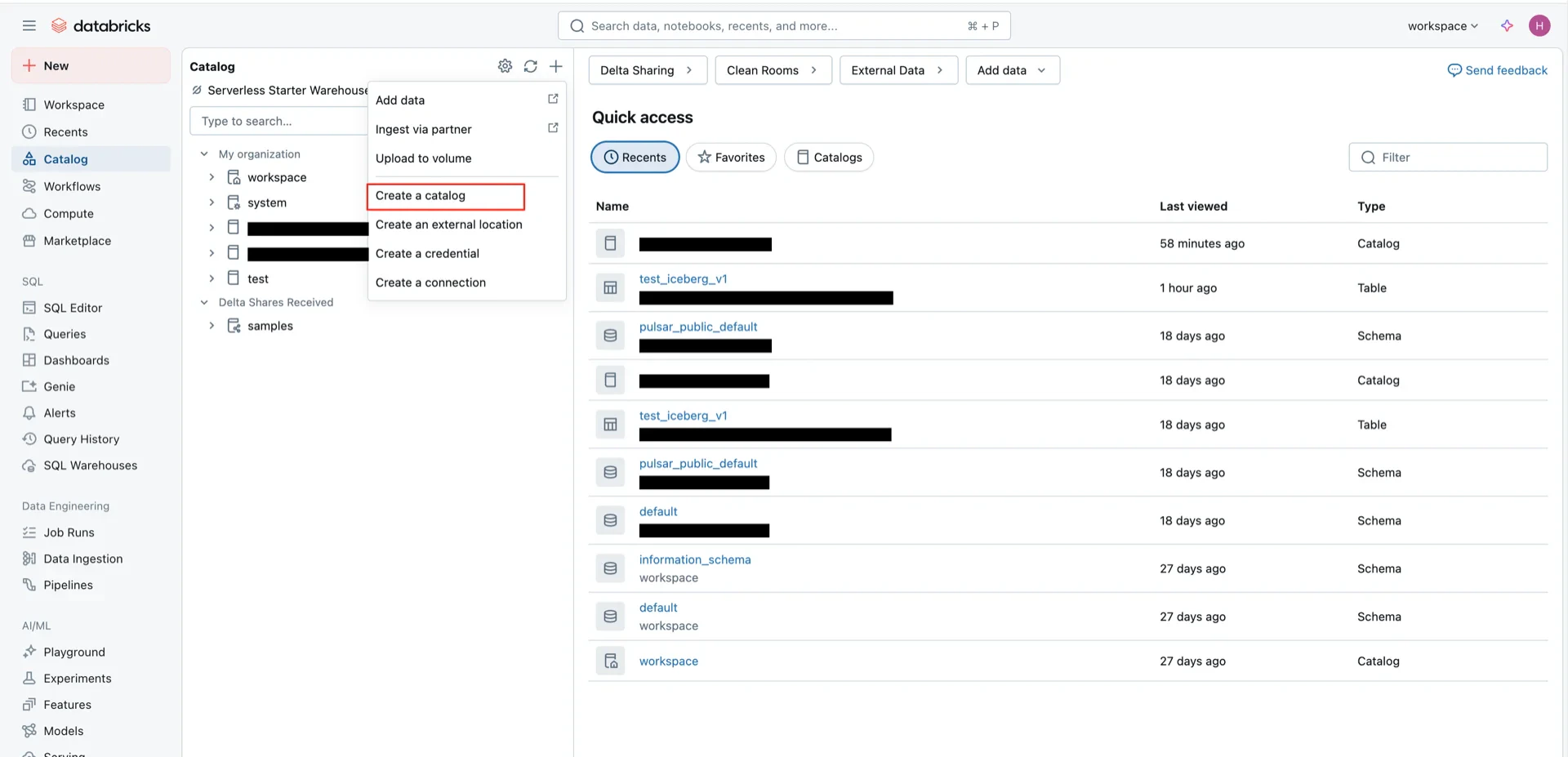
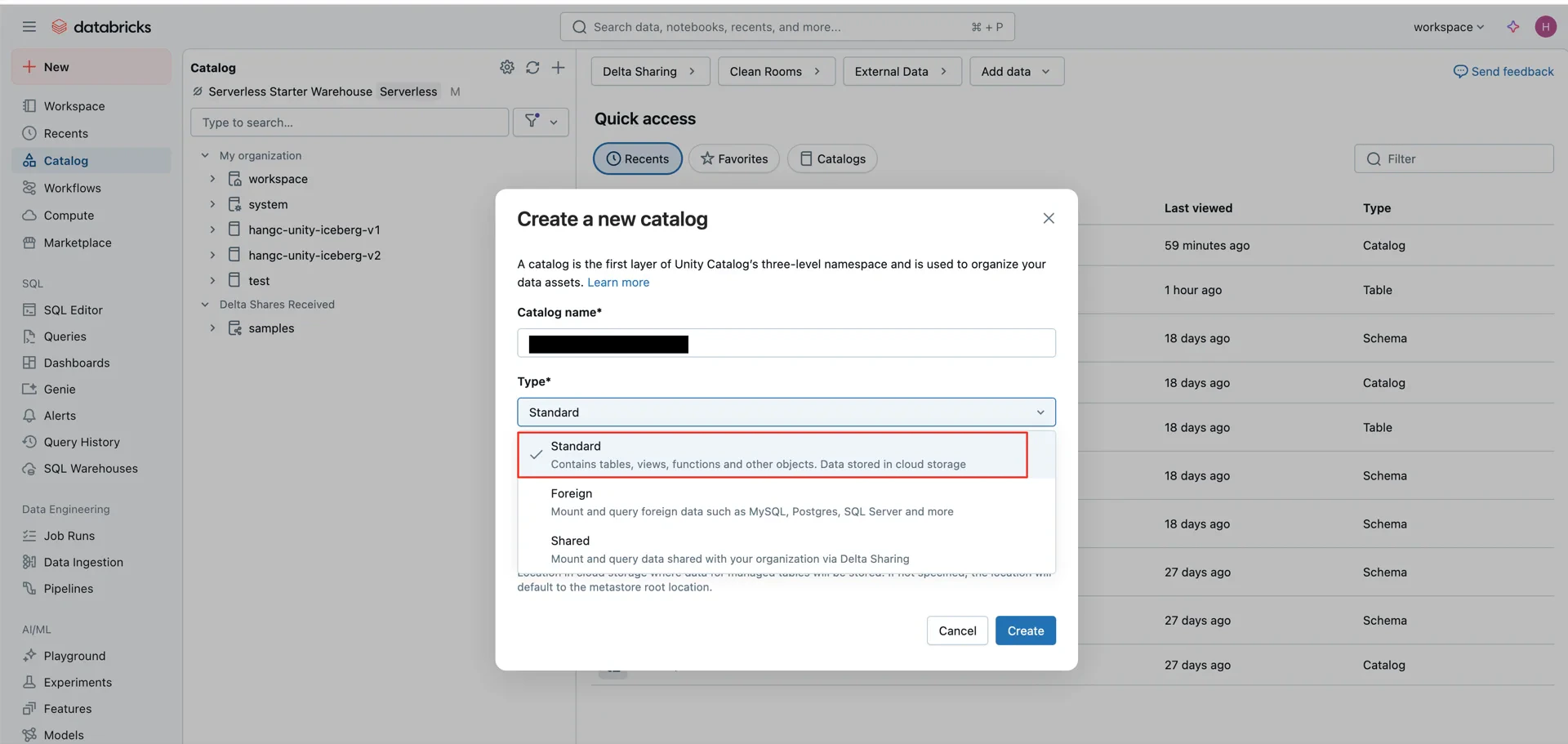
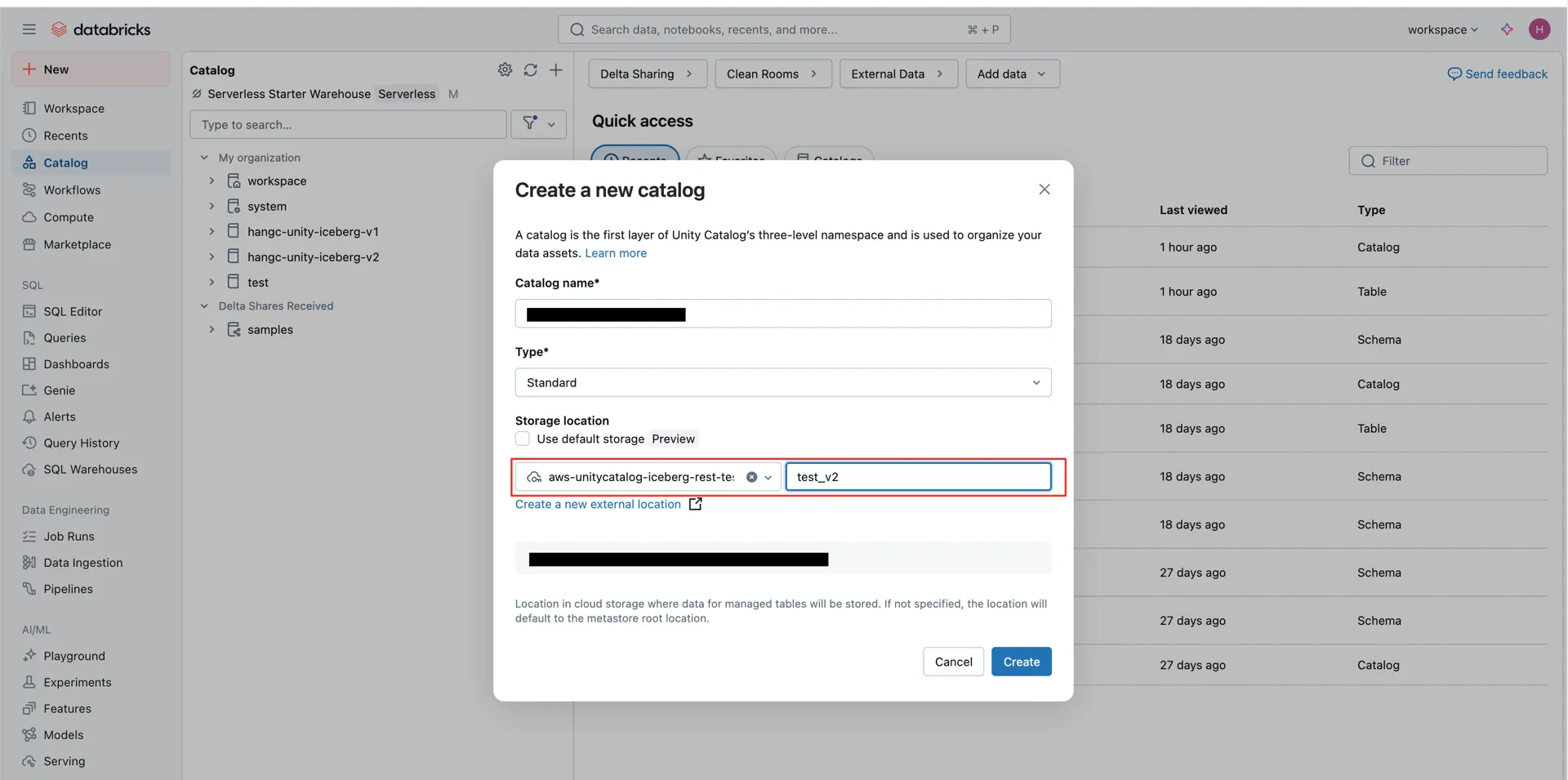
Create a new catalog in Databricks bound to the external location created in step 3:
* **Type:** Standard
* **Storage location:** the external location created above
## 5. Create the Unity Catalog
Create a new catalog in Databricks bound to the external location created in step 3:
* **Type:** Standard
* **Storage location:** the external location created above
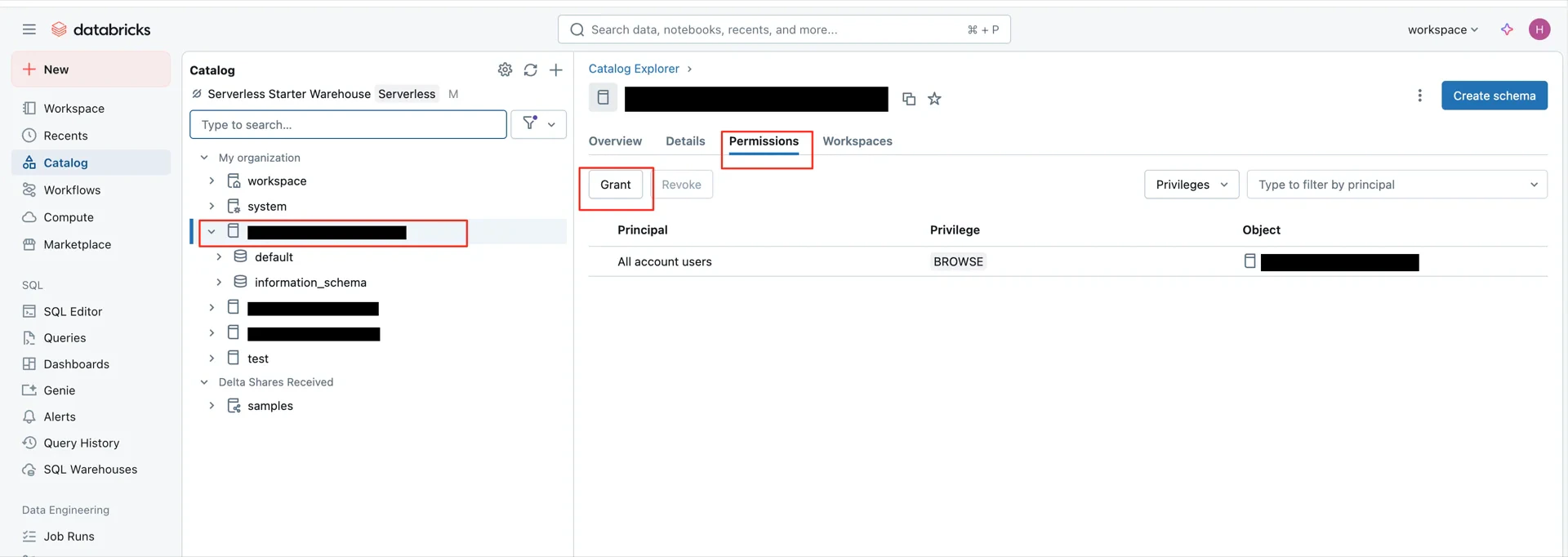
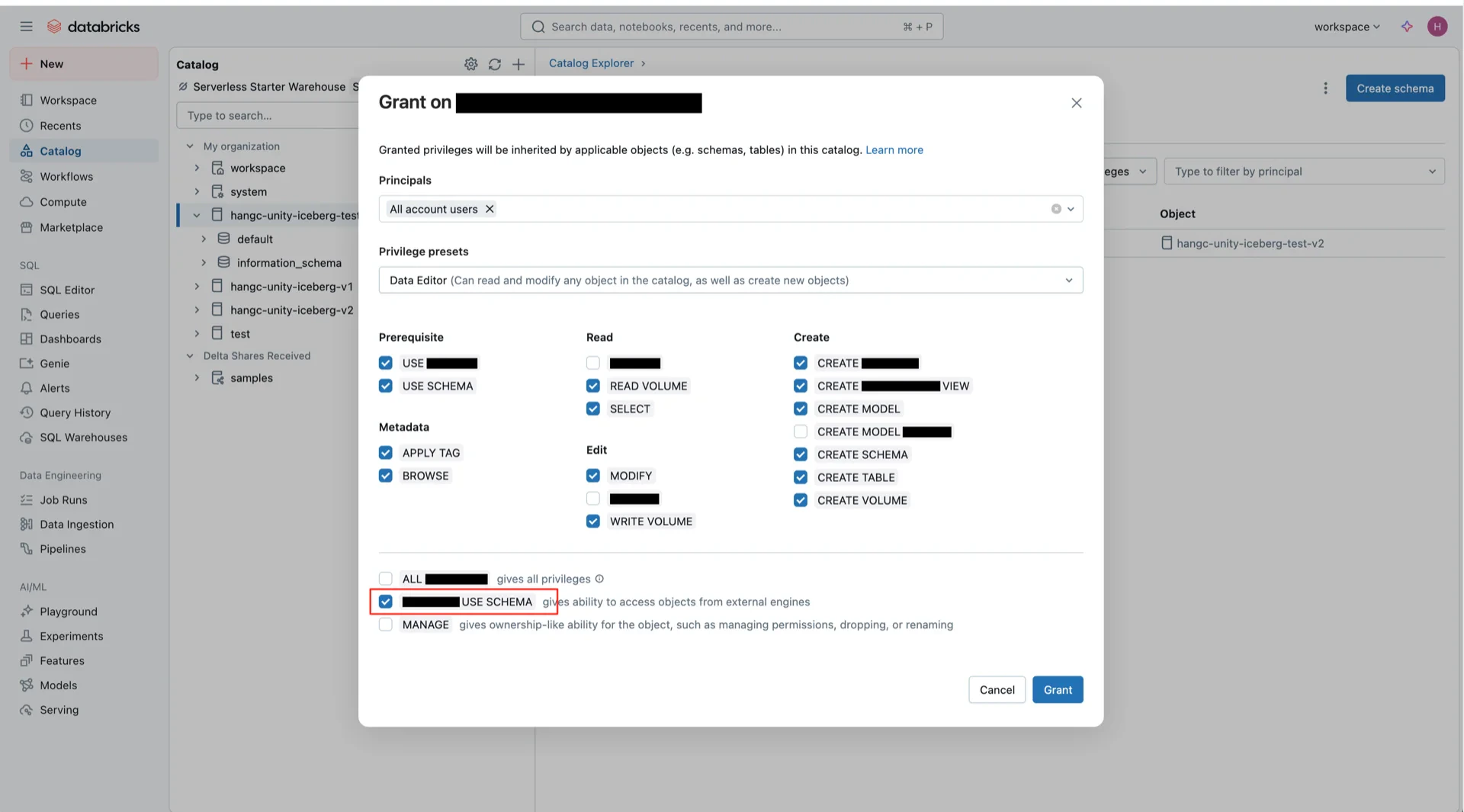
 ## 6. Grant Catalog Permissions
Grant permissions on the catalog. The `EXTERNAL_USE_SCHEMA` permission is **required** for Iceberg Managed Tables in Unity Catalog.
## 6. Grant Catalog Permissions
Grant permissions on the catalog. The `EXTERNAL_USE_SCHEMA` permission is **required** for Iceberg Managed Tables in Unity Catalog.
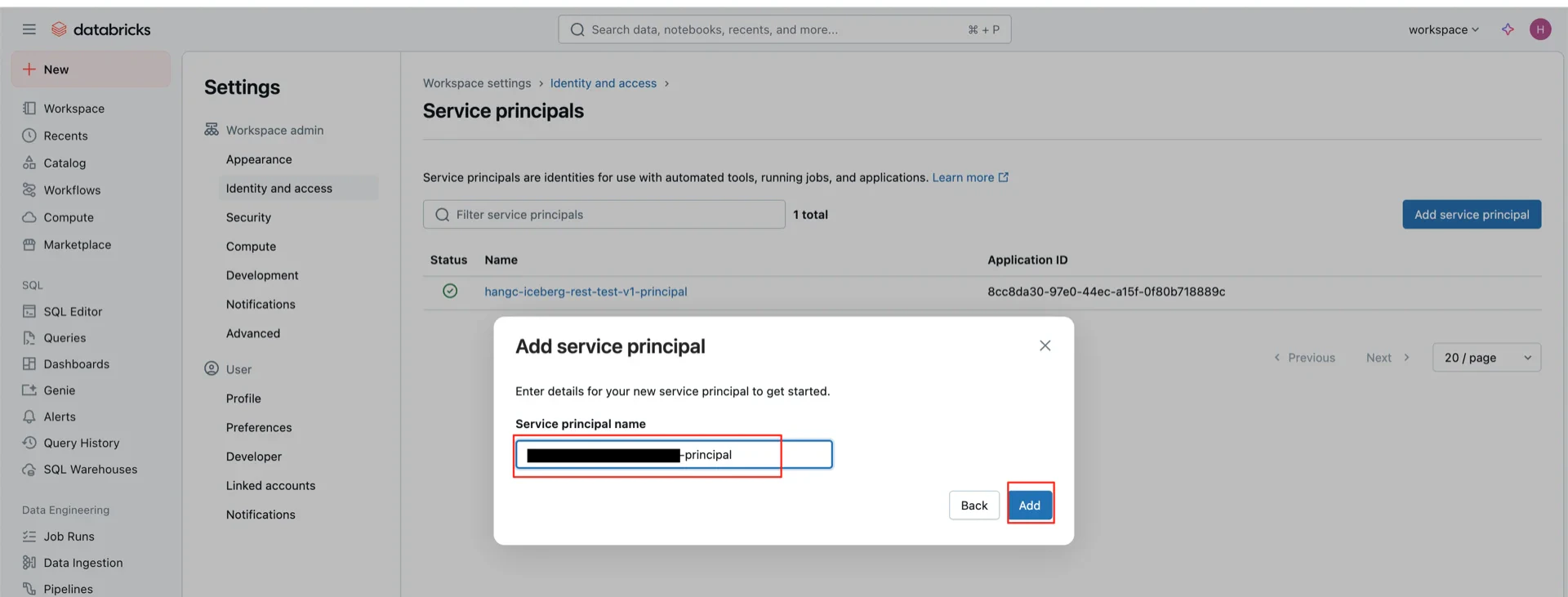
 ## 7. Create OAuth2 Credentials
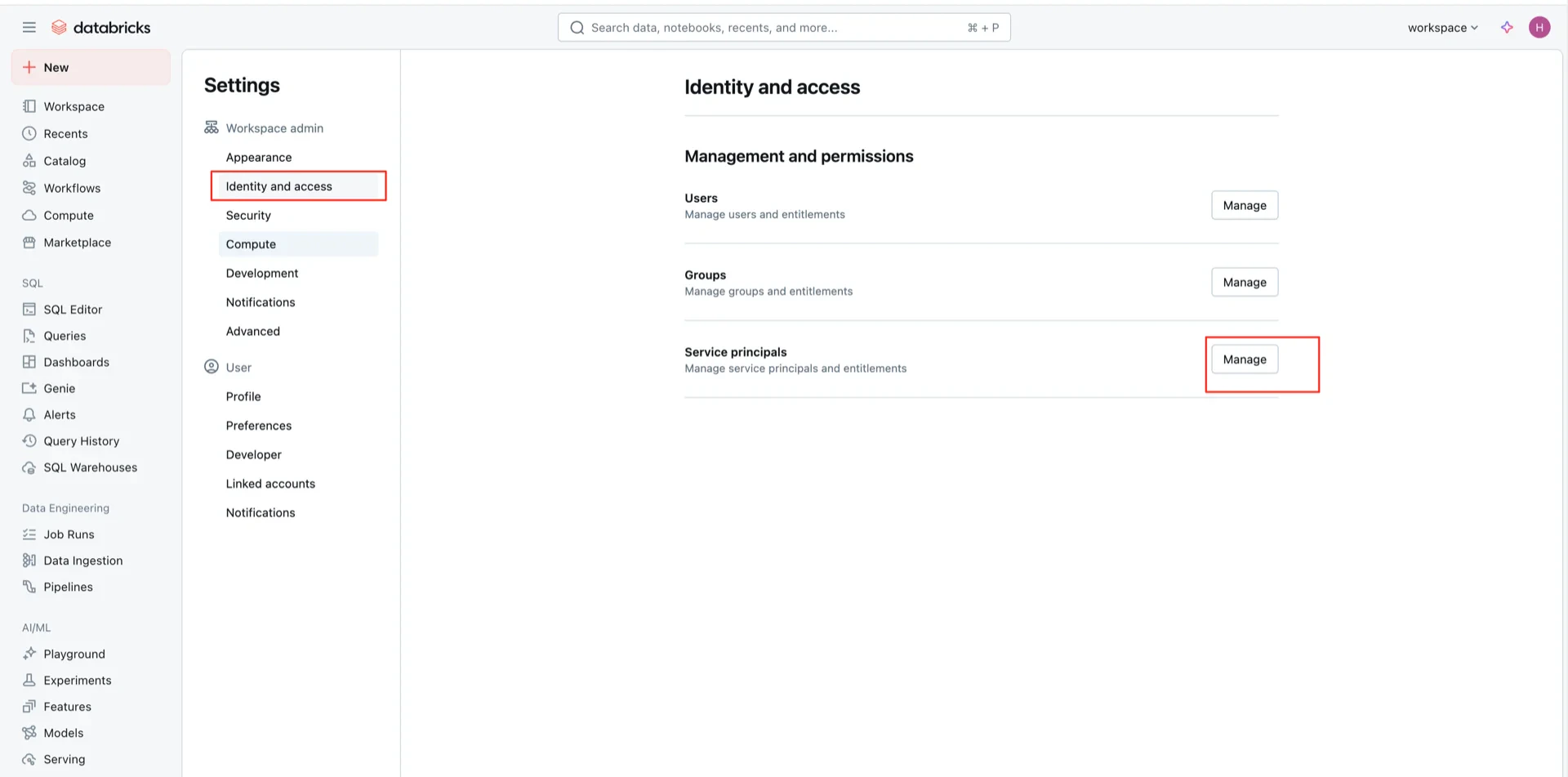
Create an OAuth2 service principal that StreamNative Ursa will use to authenticate against Unity Catalog.
## 7. Create OAuth2 Credentials
Create an OAuth2 service principal that StreamNative Ursa will use to authenticate against Unity Catalog.
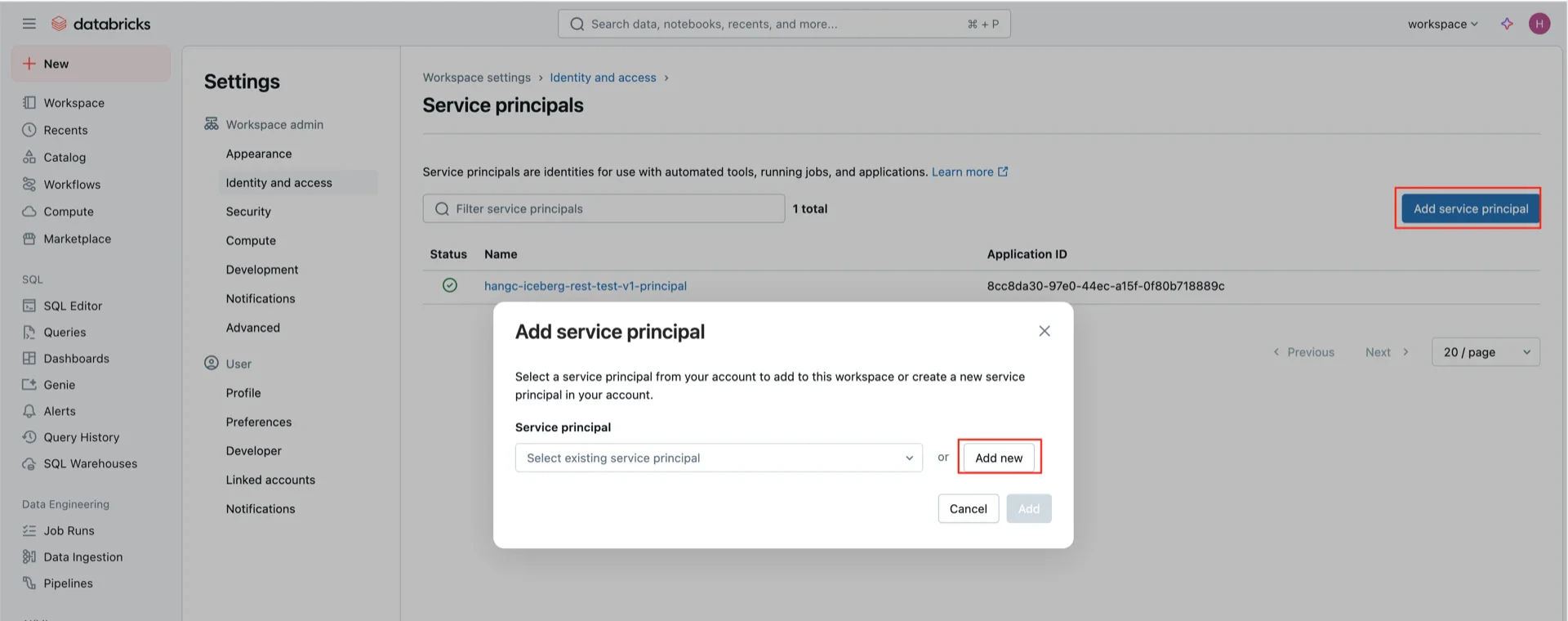
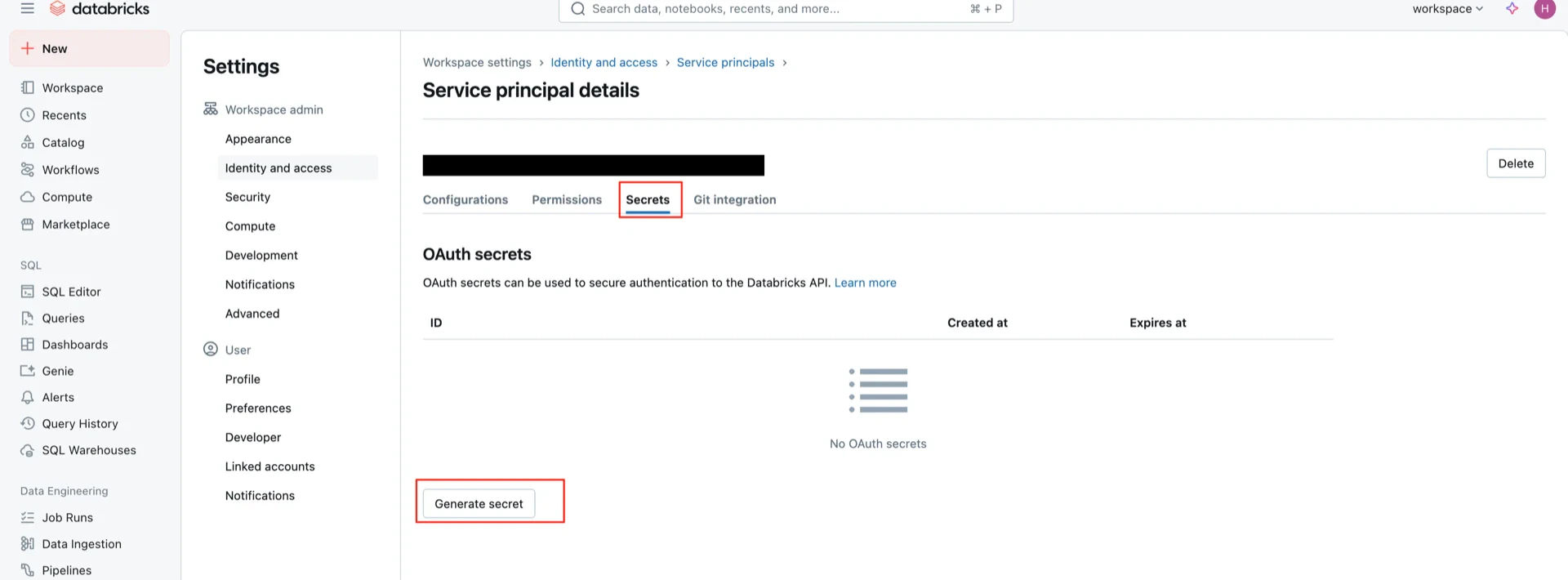
 Generate a secret for the principal and record both the **Client ID** and **Client Secret**.
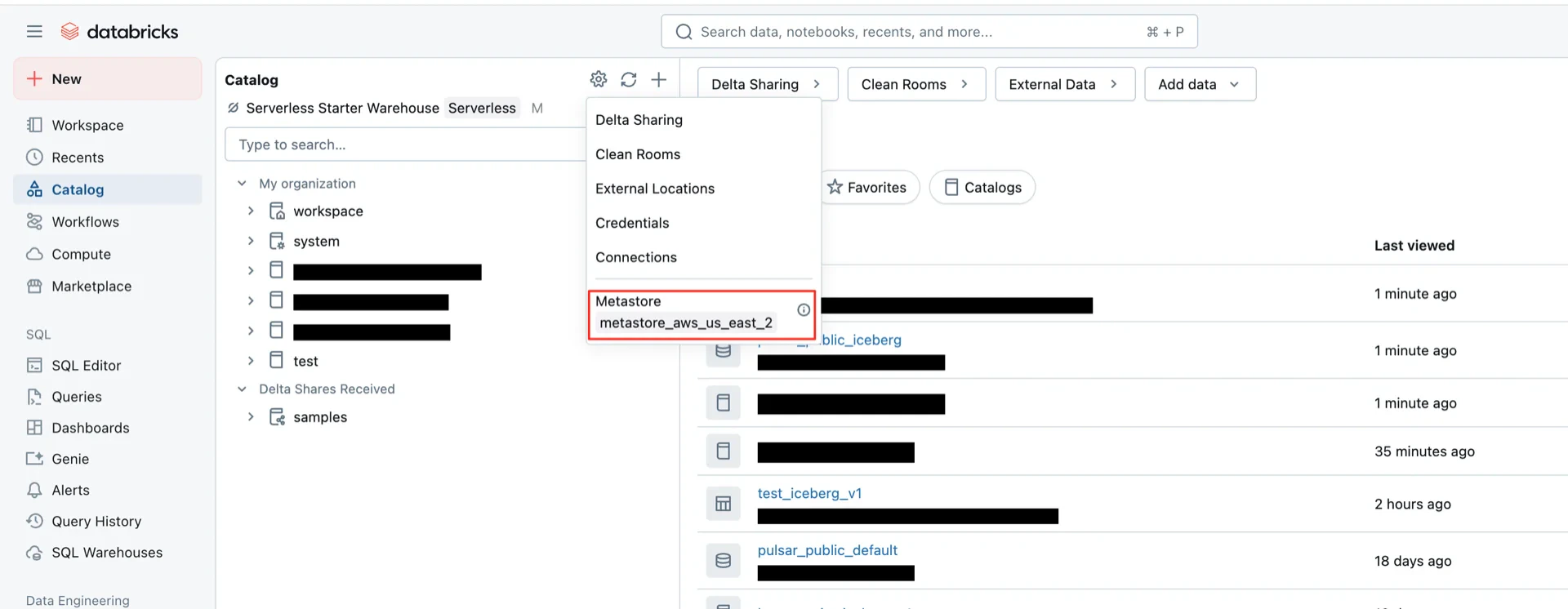
 ## 8. Enable External Data Access on the Metastore
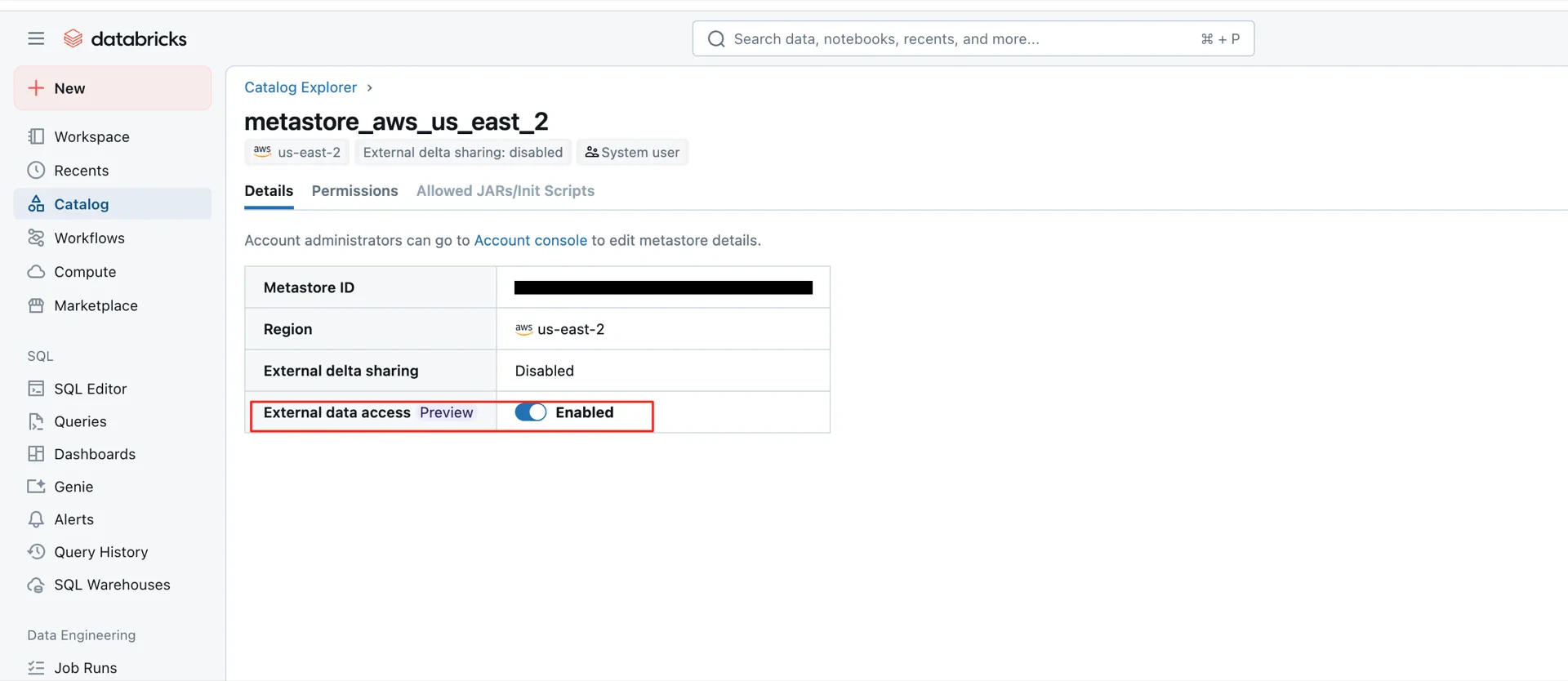
This step is **required** for Unity Catalog Iceberg Managed Tables. Enable **External data access** on the metastore in Databricks.
## 8. Enable External Data Access on the Metastore
This step is **required** for Unity Catalog Iceberg Managed Tables. Enable **External data access** on the metastore in Databricks.
 ## Catalog Information Summary
When the steps above are complete, collect the following values for the StreamNative Ursa compaction service:
| Value | Description |
| ---------- | ----------------------------------------------------------------------------------------------------------- |
| URI | Databricks workspace URL (e.g., `https://dbc-xxxx.cloud.databricks.com/api/2.1/unity-catalog/iceberg-rest`) |
| Warehouse | The Unity Catalog name created in step 5 |
| Credential | `:` from step 7 |
For the next steps, see [Register Lakehouse Catalogs](/cloud/lakehouse/catalogs/register-catalog).
## Catalog Information Summary
When the steps above are complete, collect the following values for the StreamNative Ursa compaction service:
| Value | Description |
| ---------- | ----------------------------------------------------------------------------------------------------------- |
| URI | Databricks workspace URL (e.g., `https://dbc-xxxx.cloud.databricks.com/api/2.1/unity-catalog/iceberg-rest`) |
| Warehouse | The Unity Catalog name created in step 5 |
| Credential | `:` from step 7 |
For the next steps, see [Register Lakehouse Catalogs](/cloud/lakehouse/catalogs/register-catalog).